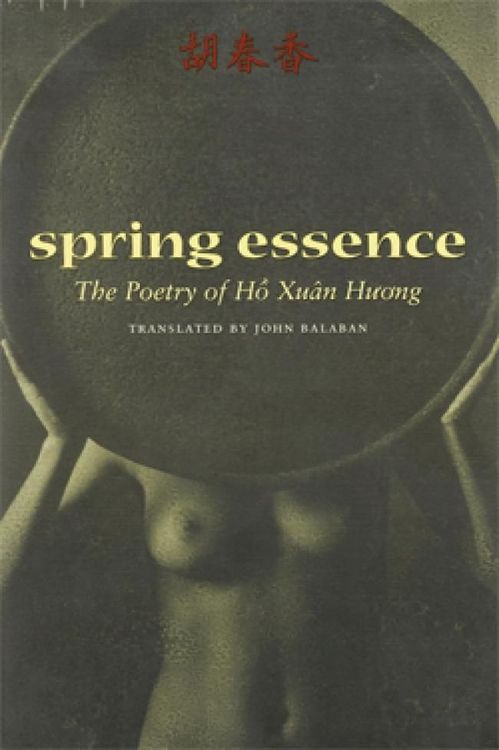
Poetry of Hồ Xuân Hương
Poetry of Hồ Xuân Hương presents the bold and singular voice of Hồ Xuân Hương (c. 1775–1820s), one of Vietnam’s most celebrated poets. Writing during a time of political turmoil and social decline, she broke barriers as a woman composing poetry in chữ Nôm, the script of the Vietnamese vernacular, rather than classical Chinese. Her poems, rich with wit and double meanings, challenged the Confucian norms of her time. Beneath the elegant surface of her lu-shih verse lies sharp critique—of gender inequality, sexual repression, and religious hypocrisy. Ordinary objects like fans, swings, and fruit become vehicles for subtle eroticism and satire, making her poetry both daring and deeply human. Despite her audacity, Hồ Xuân Hương was widely respected for her literary skill. Her verses reflect not only humor and sensuality, but also spiritual longing and a search for justice and love.
Spring Essence: The Poetry of Hồ Xuân Hương
Hồ Xuân Hương—whose name means “Spring Essence”—is one of the most distinctive and influential female poets in the history of Vietnamese literature. As a woman living in a Confucian society full of constraints, she asserted her voice through extraordinary poetic talent. Her poems, composed in the elegant form of classical Chinese lu-shih, are bold in content, employing double entendre and erotic innuendo to deliver sharp critiques of gender inequality, hypocrisy, and societal norms of her time. The publication of Spring Essence marks a major milestone in introducing Hồ Xuân Hương’s poetry to international audiences. The work is presented in a tri-graphic format—featuring English translations, modern quốc ngữ Vietnamese script, and chữ Nôm, the calligraphic writing system once used to record the Vietnamese language for over a millennium. This is also the first time that chữ Nôm has been printed using moveable type, opening new possibilities for the recovery of a vital part of Vietnam’s linguistic and literary heritage. The translator, John Balaban, a two-time finalist for the National Book Award, is one of the foremost American scholars of Vietnamese literature. He returned to Vietnam after the war to document oral poetry traditions—a groundbreaking endeavor that helped preserve Vietnam’s vernacular literary culture. Supporting the project is Ngô Thanh Nhàn, a computational linguist at New York University, who digitized the ancient Nôm script and made possible the technical foundation for this important publication.
Featured Articles
The Poetry of Ho Xuan Huong: Echoes between Stillness and Motion, between Intuition and Form
October 22, 2025
The Poetry of Ho Xuan Huong: Echoes between Stillness and Motion, between Intuition and Form

Hồ Xuân Hương’s title as “The Queen of Nôm Poetry” (a phrase coined by poet Xuân Diệu) perhaps best reflects the immense influence and rebellious force of her verse. Born around 1772, at the end of the Lê dynasty (which lasted from 1592–1788), she is thought to have been the daughter of Hồ Sĩ Danh (1706–1783) or Hồ Phi Diễn (1703–1786), and the child of a concubine. Because of her social position, she likely did not receive the same formal education as men or royal women. Yet she composed poetry in both classical Chinese and Nôm (Vietnamese demotic script)—around 150 poems are recorded—and became especially renowned for her Nôm works.


Instead of adhering to rigid conventions, allusions, and classical references typical of Sino-cultural poetry, Hồ Xuân Hương’s choice to write in Nôm—the vernacular language of everyday life—freed her from Confucian literary constraints, allowing her to speak with a distinct personal voice. Her inspiration sprang from the most ordinary experiences: “a betel quid,” “a floating cake,” “a jackfruit on a tree,” “a snail’s lot,” “a patch of foul grass,” and even more abstract expressions like “the beauty” (in Self-Lament). One of her special talents lies in expressing delicate or elusive ideas through earthy, colloquial imagery.


As noted in The Annotated Nôm Dictionary (edited by Prof. Nguyễn Quang Hồng), the word cái (丐) has multiple meanings: it can designate an object, mark femininity (in contrast to masculinity), mean “mother,” or refer to something greater (as in “trống cái” – the main drum, “đường cái” – main road). Meanwhile, hồng nhan (紅顔, literally “rosy face”) evokes a more elusive sense—perhaps a beautiful young woman, perhaps destiny or romance (since hồng can mean both “red” and “fate”). When combined as cái hồng nhan, femininity is embodied yet impossible to define precisely—a poetic tension between presence and abstraction.


Although her poem titles often suggest still scenes or quiet objects—“The Jackfruit,” “Autumn Scene,” “The Snail,” “The Floating Cake,” “The Crab”—each line is full of motion. Hồ Xuân Hương’s poetry does not merely describe things as static objects but speaks through them, claiming agency even in seemingly modest tones:


“My body is white, my fate is round” (The Floating Cake)
“My body is like a jackfruit on the tree” (The Jackfruit)
“I wear a green tunic, a yellow bodice / Three soldiers carry my palanquin, high and proud” (The Crab)


Her verbs dominate the verse, imbuing it with a sense of vitality and rhythm. Sometimes action even precedes the subject, creating a world brimming with energy and embodiment:


“Green wraps the tree trunk with a rounded crown,
White spreads across the calm, silent stream.” (Autumn Scene)


The movement in Hồ Xuân Hương’s poetry also resides in her layered wordplay. She was a master of “đố tục giảng thanh” (using the vulgar to express the pure) and “đố thanh giảng tục” (using the pure to express the vulgar)—fusing the sacred and profane through clever double meanings. It was this semantic dynamism that gave her poetry such vitality. Drawing from familiar natural and domestic imagery, she hinted at erotic and reproductive themes:


“The white bridge, two planks joined as one,
Clear water flows straight below!
Wild grass curls along the edges,
Tiny fish dart through the stream.”


In a Confucian society where female chastity defined virtue and sexuality was taboo, such multi-layered verses became subtle acts of resistance against moral repression. Yet Hồ Xuân Hương’s poetry transcends the simple dichotomy of sacred and profane. Its multiple layers often reflect broader social, religious, and even national questions—as seen in the word nước non (“water and mountains”) in The Floating Cake, linking personal fate to the destiny of the homeland and its folk roots.


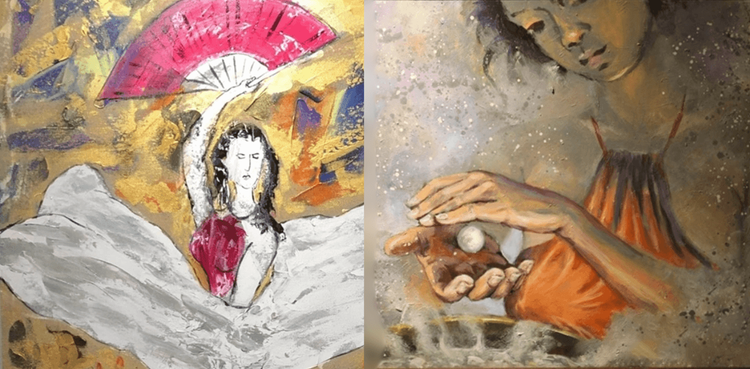
Image source: Works by Nguyen Quoc Thang and Nghiem Nhan, published on VOV.