Revisiting Sino-Origin Vocabulary in Vietnamese: A Historical Phonological Perspective
Vietnam and China, with their long history of contact, have formed a deep relationship of cultural exchange in which language is one of the most visibly affected areas. For more than two millennia, Chinese has not only served as a vehicle for transmitting culture and thought, but has also left an indelible mark on the structure and vocabulary of Vietnamese. Sino-origin words have penetrated deeply into Vietnamese life and thought, becoming an essential part of the language and enriching and diversifying Vietnamese expression.
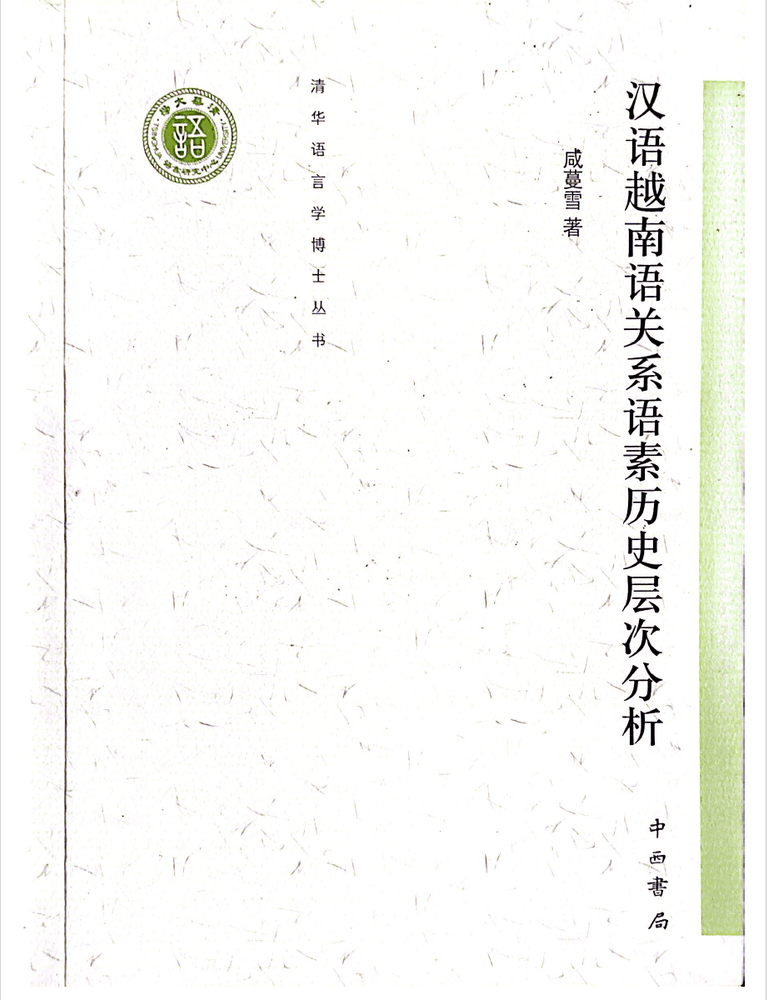
The study Hanyu Yuenanyu Guanxi Yusu Lishi Cengci Fenxi (《汉语越南语关系语素历史层次分析》 - “Historical Stratification of Sino-Origin Elements in Vietnamese”) by Assoc. Prof. Dr. Xian Manxue is an in-depth work applying the method of historical phonological comparison to identify, classify, and date when Sino-origin words entered Vietnamese. The research does not stop at the familiar layer of so-called Sino-Vietnamese vocabulary, but also uncovers older layers of borrowings, thereby sketching a vivid and panoramic picture of the history of Han–Viet linguistic contact. This article introduces the main ideas and key findings of that work.
- BASIC CONCEPTS
As we know, for many centuries of Vietnamese history, Classical Chinese was used as the official written language. During this period, a large number of Sino-origin words entered Vietnamese, became part of everyday usage, and today are inseparable from modern Vietnamese.
We are familiar with “Sino-Vietnamese words,” that is, words read according to “Sino-Vietnamese readings,” a system of pronouncing Chinese characters based on the phonological system of Middle Chinese in the Tang dynasty, specifically reflecting Chinese of around the 8th century. Examples include: học ‘study’, dân ‘people’, sách ‘book’, văn chương ‘literature’, giáo dục ‘education’, xã hội ‘society’, văn hóa ‘culture’, đạo đức ‘morality’, tình cảm ‘emotion’, gia đình ‘family’, phụ huynh ‘parent’.
However, not all Sino-origin words in Vietnamese belong to this Sino-Vietnamese layer. There are also words like bay ‘fly’, buồn ‘sad’, búa ‘axe’, gương ‘mirror’, ghế ‘chair’, gươm ‘sword’, giếng ‘well’, dao ‘knife’, mùa ‘season’… which at first sound “purely Vietnamese,” but in fact also trace back to Chinese. Their modern forms differ from standard Sino-Vietnamese because they were borrowed very early and became assimilated into Vietnamese; or because they underwent long-term “Vietnamization” after borrowing; or because they entered through spoken contact rather than through the written/literary channel. These words are crucial for tracing the oldest layers of Han–Viet contact.
These items preserve information about historical phonology and carry traces of Sino–Vietnamese cultural exchange across different periods. Analyzing the relationship between such Vietnamese words and earlier stages of Chinese helps us reconstruct both the linguistic contact history between Chinese and Vietnamese and the cultural exchange between the two societies.
To cover this full range, the study adopts a broader concept: “Sino-origin elements in Vietnamese.” This term refers to all monosyllabic Vietnamese words that show systematic phonological and semantic correspondence to a Chinese form, regardless of which layer they belong to or when they were borrowed. This approach allows for a more comprehensive and systematic view of Chinese influence on Vietnamese.
THE METHOD OF HISTORICAL PHONOLOGICAL COMPARISON: Reconstructing history through sound
Each Sino-origin element—Sino-Vietnamese or non–Sino-Vietnamese—functions like a “fossil pebble,” preserving the phonetic features of the period in which it entered Vietnamese. To decode that historical information, the key method is historical phonological comparison.
We use historical phonological comparison based on the principle of “full correspondence” across three components: initial consonant, rhyme (vowel + coda), and tone, in order to identify Sino-origin elements in Vietnamese, especially those outside the standard Sino-Vietnamese system. In other words, a word is only considered Sino-origin if it shows regular patterned correspondences in all three aspects. This principle prevents arbitrary or accidental comparisons and ensures scientific rigor and reliability.
Then, based on known historical sound changes in both Chinese and Vietnamese, we “stratify” these Sino-origin elements by period—that is, we determine when they were borrowed into Vietnamese.
Some illustrations:
– Initial consonants: The character 斧 ‘axe’ has the Sino-Vietnamese reading phủ, but Vietnamese also has búa ‘axe’. The initial b- in búa reflects an earlier stage before the emergence of an [f]-like initial (ph-) in Chinese, i.e. before the 8th century. Therefore búa is an archaic borrowing. Other items of this type include: buồm (帆 SV: phàm, ‘sail’), buồn (烦 SV: phiền, ‘sad’), buông (放 SV: phóng, ‘let go’), buồng (房 SV: phòng, ‘room’), bùa (符 SV: phù, ‘talisman’), bay (飞 SV: phi, ‘fly’).
– Rhymes: The character 惜 ‘to regret’ has the Sino-Vietnamese reading tích, but Vietnamese also has tiếc ‘to regret’. The rhyme correspondence -ích ~ -iếc reflects an older stage. Other pairs include: biếc (碧 SV: bích, ‘azure’), tiệc (席 SV: tịch, ‘banquet’), chiếc (只 SV: chích, ‘classifier for single items’), thiếc (锡 SV: tích, ‘tin’), việc (役 SV: dịch, ‘work, task’), giêng (正 SV: chinh, ‘first month’).
Using this procedure, the study identifies 3,938 Sino-origin elements, of which 1,012 lie outside the standard Sino-Vietnamese reading system—that is, very early borrowings or forms that have been strongly reshaped. According to historical sound change patterns, these are assigned to four main strata:
– Archaic (Qin–Han period);
– Early Medieval (late Eastern Han to early Tang);
– Late Medieval (mid-Tang to Five Dynasties);
– Later / Early Modern and after (from the 10th century onward). (These labels follow traditional periodization in Chinese historical linguistics.)
- THE HISTORY OF HAN–VIET CONTACT THROUGH LEXICAL DISTRIBUTION
Analyzing how these elements are distributed across time helps us sketch an overall history of Sino–Vietnamese language contact.
3.1 Qin–Han period: First contact
Han–Viet linguistic contact begins here. 386 items belong to this earliest layer. Especially in the mid-to-late Eastern Han, many scholars from the Central Plains migrated south to escape turmoil. The historical figure Sĩ Nhiếp (Sĩ Vương) is often credited with promoting Han culture in the region. Historical sources note that he opened schools, used canonical texts from the north, glossed and explained them, and taught local people—evidence that aligns with what we see linguistically.
3.2 Early Medieval period (late Eastern Han to early Tang)
By this stage, there are already semantic clusters, suggesting contact on a meaningful scale.
- The Heavenly Stems and Earthly Branches / calendrical cycle: terms like tý (子), dần (寅), thìn (辰), ngọ (午), mùi (未), dậu (酉), bính (丙), quý (癸) entered Vietnamese early, reflecting cultural transfer and practical needs.
Color terms: Many Vietnamese color words derive from Chinese: hồng (红 ‘red’), vàng (黄 ‘yellow’), xanh (青 ‘blue/green’), tía (紫 ‘purple’), cam (柑 ‘orange’), biếc (碧 ‘bright blue/green’). Notably, vàng, tía, biếc belong to this Early Medieval layer. The word xanh in Vietnamese can mean both ‘green’ and ‘blue’, mirroring the older semantic range of 青 qīng in Classical Chinese. The well-known saying 青出于蓝而胜于蓝 (“Blue/green comes from indigo but surpasses indigo”) reflects this older linkage between shades of green and blue within 青. Vietnamese xanh preserves that ancient semantic field.
3.3 Late Medieval period
This is the peak of large-scale, structured Han–Viet contact and the period that gave rise to the Sino-Vietnamese reading system. Most of the 3,938 Sino-origin elements belong to this layer. As shown by Nguyễn Tài Cẩn, borrowings from the mid-Tang era provided the foundation for the Sino-Vietnamese readings that later became standard.
From the 10th century onward, after Vietnam entered an era of political independence, linguistic self-consciousness encouraged the development of a distinct national language. The Sino-Vietnamese reading system was gradually absorbed into the internal sound structure of Vietnamese and continued to evolve according to Vietnamese phonological rules. Sino-Vietnamese words became organically embedded in Vietnamese and to this day remain productive for forming new terms to express modern concepts, e.g. nhiệt kế ‘thermometer’, khí quyển ‘atmosphere’, vi mô ‘micro-’, vĩ mô ‘macro-’, thị trường ‘market’, công ty ‘company’, công nghệ cao ‘high technology’, toàn cầu hóa ‘globalization’.
3.4 From the 10th century onward
Even after independence, contact did not end. Literary Chinese continued to feed new borrowings. At the same time, continuing waves of migration from southern Chinese regions (Cantonese, Teochew, Hokkien, etc.) introduced new Sino-origin words via spoken channels, especially in southern Vietnam. Words such as xá xíu (barbecued pork), hủ tiếu (rice-noodle soup), lẩu (hotpot), quẩy (fried cruller), xì dầu (soy sauce), sa tế (satay-style chili paste), bò bía (spring rolls) are vivid examples. These forms are colloquial, culinary, and everyday in flavor—quite different from the elevated, classical tone of formal Sino-Vietnamese vocabulary.
In short, studying how these Sino-origin layers are distributed over time gives us a powerful way to reconstruct the linguistic history of Han–Viet contact.
NEW INSIGHTS FROM THE FINDINGS
4.1 “Sino-Vietnamese readings”: a historically layered system
One key finding is that the Sino-Vietnamese reading system is not a single homogeneous block created all at once. Rather, it is historically layered. Sino-Vietnamese forms appear across all four strata: 37 items in the Archaic layer, 256 in the Early Medieval layer, most in the Late Medieval layer, and 10 in the Later/Early Modern layer. This shows that some very old borrowings were never replaced by later “standard” Tang-era readings; they persisted into what we now consider Sino-Vietnamese. Examples include: nghĩa (义 ‘meaning’), địa (地 ‘earth’), thìa (匙 ‘spoon’), thuộc (属 ‘to belong’), tý (子, calendrical cycle), bính (丙, calendrical cycle), đóa (朵 ‘classifier for flowers’).
4.2 “Vietnamization” does not always mean “modified Sino-Vietnamese”
Traditionally, many forms that differ from standard Sino-Vietnamese readings have been explained as “Sino-Vietnamese that later got localized.” However, stratification shows a different reality: many such words—gương ‘mirror’ (镜), gươm ‘sword’ (剑), ghế ‘chair’ (几), ghi ‘to record’ (记), gần ‘near’ (近), dừng ‘to stop’ (停), giếng ‘well’ (井)—were in fact borrowed very early, before the Sino-Vietnamese system crystallized. They are not “later distortions” of Sino-Vietnamese; they are older borrowings that preserve pre–Sino-Vietnamese phonology. Calling them “Vietnamized Sino-Vietnamese” obscures their true historical depth.
SIGNIFICANCE OF THE STUDY
This study is not only for linguists; it speaks to anyone interested in the origins of Vietnamese and the broader history of Vietnamese culture.
– Clarifying the history of Vietnamese: By extracting and decoding the historical information embedded in Sino-origin vocabulary, we gain a more concrete and nuanced understanding of how Vietnamese has received, filtered, and naturalized external elements across different eras.
– Supporting teaching and learning: For learners of both Vietnamese and Chinese, understanding historical sources, etymological connections, and regular sound correspondences helps organize vocabulary in a systematic, intellectually coherent way.
– Contributing to interdisciplinary research: Language is a faithful record of history and culture. By dating borrowings, we obtain valuable evidence to verify, supplement, and illuminate historical events and the long, layered process of Sino–Vietnamese cultural exchange spanning more than two thousand years.
CONCLUSION
Sino-origin vocabulary is a structural component of Vietnamese, contributing to its richness, nuance, and expressive flexibility. Tracing the origins and development of these elements does more than clarify the linguistic past; it gives us a clearer view of the diversity and vitality of Vietnamese today.
Through the lens of historical phonological comparison, the work of Assoc. Prof. Dr. Xian Manxue lifts the veil of time and reveals the living record of deep cultural contact between Vietnam and China—a relationship inscribed, with great subtlety and persistence, into the languages of both peoples. Language here is not only a tool of communication, but a historical witness, a cultural bridge, and a shared heritage that deserves ongoing study and care.