Rethinking the Vietnam War: New Historiographical Perspectives from Pierre Asselin and Lien-Hang T. Nguyen
The study of the Vietnam War has undergone a significant transformation in recent decades. No longer confined to U.S.-centered narratives of policymaking and battlefield operations, scholarship increasingly situates the conflict within broader Vietnamese, regional, and global contexts. The works of Pierre Asselin and Lien-Hang T. Nguyen stand at the forefront of this shift, offering deeply researched and analytically rich contributions that illuminate the war’s complexities. Their publications—ranging from Asselin’s explorations of Hanoi’s revolutionary strategy to Nguyen’s international framing of the conflict, along with their joint editorial work on The Cambridge History of the Vietnam War—reveal the war as a multifaceted struggle shaped by ideology, diplomacy, and society. This review examines several of their major contributions, underscoring how they collectively challenge entrenched myths, complicate our understanding of Vietnamese unity, and broaden the historiographical lens on one of the twentieth century’s most devastating wars.
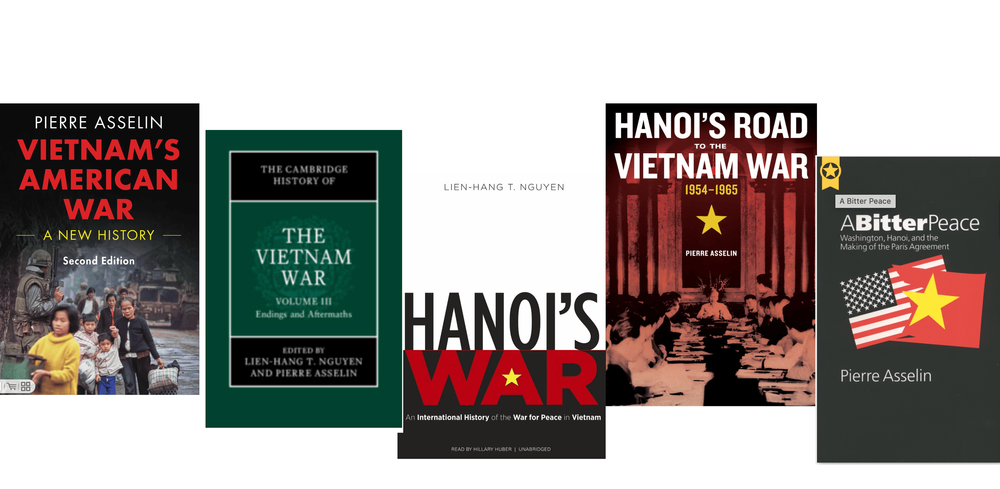
Vietnam’s American War – A New History (2nd Edition) by Pierre Asselin, Cambridge University Press, 2024
The Vietnam War cannot be understood solely as a sequence of military engagements. To comprehend its true significance, one must examine the wider political, social, and cultural forces that informed communist strategy. In its expanded second edition, Vietnam’s American War remains focused on explaining Hanoi’s victory, but now incorporates a much deeper analysis of Southern Vietnamese politics and society. Asselin dismantles the myth of a unified Vietnam by highlighting the divisions intensified by U.S. intervention. With more than thirty-five newly added images, the work underscores the fundamentally civil and tragic nature of the conflict. Richly detailed and highly original, the book continues to serve as an essential account of the war’s dynamics.
The Vietnam War (Volume III: Endings and Aftermaths) edited by Lien-Hang T. Nguyen (Columbia University) and Pierre Asselin (San Diego State University), Cambridge University Press, 2024
The concluding volume of The Cambridge History of the Vietnam War situates the war’s final years and aftermath within domestic, regional, and global contexts, including its legal, environmental, and memorial legacies. These later stages of the conflict marked a decisive Cold War moment, shaped by Sino-Soviet discord, Sino-American rapprochement, superpower détente, and transnational cultural movements. The war’s expansion into Cambodia and Laos further elevated its geopolitical weight. Following the collapse of Saigon and national reunification in 1975–76, Hanoi’s policies towards Chinese ethnic nationality and economic difficulties produced a massive refugee crisis. This exodus reconfigured international refugee policy and permanently altered the demographic landscapes of cities across North America and Europe, underscoring the war’s enduring global impact.
Hanoi’s War – An International History of the War for Peace in Vietnam by Lien-Hang T. Nguyen, The University of North Carolina Press, 2016
Most accounts of the Vietnam War concentrate on U.S. involvement and the “Americanization” of the conflict. Nguyen, however, situates the war within an international framework, tracing North Vietnam’s efforts to wage war and America’s attempts to end it. The book moves fluidly from the Mekong Delta to the Red River Delta, and from the power centers of Hanoi, Saigon, and Washington to the negotiation tables in Paris and the political capitals of Beijing and Moscow. Nguyen demonstrates that peace in Vietnam was never a realistic prospect, as the war intensified even during the Paris peace negotiations. Drawing on newly accessible archives from Vietnam and beyond, Nguyen presents a multifaceted portrait of the war, integrating perspectives from both Vietnams, the Soviet Union, China, and the United States. The result is a groundbreaking international account that reshapes our understanding of the conflict’s scope and persistence.
Hanoi’s Road to the Vietnam War, 1954–1965 by Pierre Asselin, The University of California Press, 2015
Beginning with the Geneva Accords of 1954, which ended the Franco-Indochinese War and divided the country, Asselin traces how Hanoi transitioned from anticipation of peaceful reunification to armed conflict with the United States. Drawing on newly available Vietnamese archives and a range of international sources, he examines the internal debates and strategic decisions that led to war. His analysis makes clear that while Washington bears responsibility for escalating the conflict, North Vietnamese leaders were equally instrumental in creating the conditions that culminated in one of the Cold War’s most destructive confrontations.
A Bitter Peace – Washington, Hanoi, and the Making of the Paris Agreement by Pierre Asselin, The University of North Carolina Press, 2002
Asselin’s A Bitter Peace emphasizes the pivotal role of diplomacy in shaping the Vietnam War’s endgame. He reconstructs the clandestine negotiations that produced the Paris Agreement of 1973, which concluded U.S. involvement but failed to establish a sustainable peace. Signed under duress, the agreement was inherently fragile. For Washington, the accord secured the return of prisoners of war, a withdrawal that preserved national credibility, and an exit without formal defeat. For Hanoi, it achieved the removal of American forces, safeguarded the socialist revolution in the North, and improved prospects for reunification. Drawing on newly released sources from Vietnam, the U.S., and Canada, Asselin highlights the creative contributions of Hanoi, the National Liberation Front, and Saigon in shaping the final, ultimately flawed settlement.
Taken together, these works by Pierre Asselin and Lien-Hang T. Nguyen substantially enrich the historiography of the Vietnam War. They demonstrate that the conflict was not simply an American tragedy but a deeply Vietnamese one, rooted in internal fractures and shaped by international forces. By foregrounding the agency of Hanoi’s leaders, the complexities of Southern politics, and the broader Cold War context, their scholarship disrupts older paradigms and invites new interpretations. Moreover, their analyses of diplomacy, migration, and memory remind us that the legacies of the war extend far beyond 1975, continuing to shape societies and policies across the globe. In their breadth, originality, and archival depth, these works represent essential contributions for scholars and students seeking to understand the Vietnam War as both a national and international event of lasting consequence.