Between Order and Unruliness: Rethinking Vietnam’s Post-Colonial City
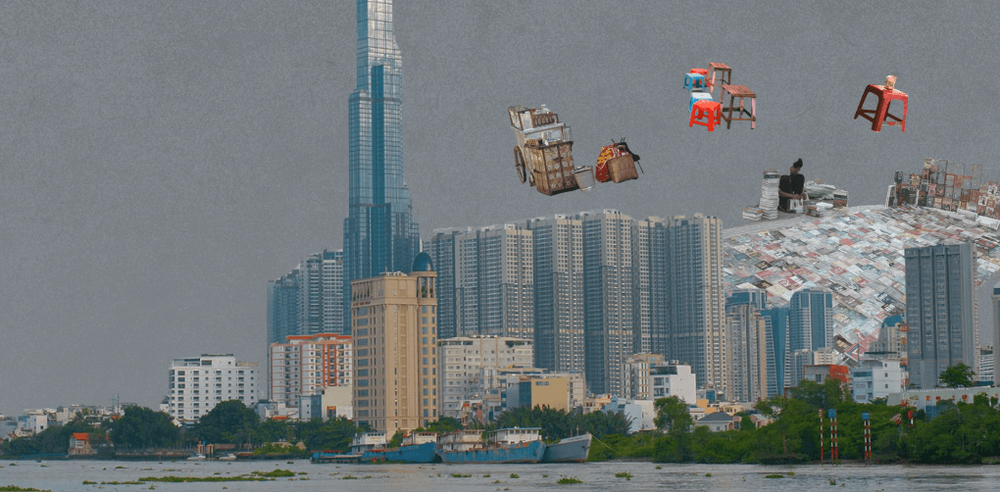
What makes a city orderly? Is it the master plan drawn by planners, the cadastral map that fixes the boundaries of every parcel of land, the household registration system that identifies who belongs where, or regulations determining how streets and sidewalks should be used? And what happens when the city encountered in everyday life refuses to conform neatly to any of these systems?
These questions lie at the center of Erik Harms and Danielle Labbé’s “Post-Colonial Urbanization in Vietnam: Urban Order and Unruliness,” a chapter in the Routledge Handbook of Contemporary Vietnam, edited by Jonathan D. London. Published as part of the handbook’s section on “Social Life and Institutions,” the chapter offers a concise but conceptually rich account of Vietnam’s urban transformation, focusing particularly on Hanoi and Ho Chi Minh City.
Rather than presenting Vietnamese urbanization simply as a story of cities becoming larger, denser, and more modern, Harms and Labbé propose a different way of reading the Vietnamese city. They ask us to see urbanization as a continual movement between two apparently contradictory forces: the desire for order and the persistence of unruliness.
The planned city and the lived city
The first of these forces is readily visible in the long history of attempts to make Vietnamese cities orderly and legible.
From the colonial period onward, urban authorities have repeatedly sought to organize space through maps, zoning, roads, administrative classifications, property regimes, and regulations. In the postcolonial and socialist periods, these ambitions took new forms. Master plans, cadastral registers, household registration, land-use regulations, campaigns for “civilized” urban behavior, and, more recently, large-scale new urban developments have all participated in efforts to produce cities that can be planned, administered, and controlled.
Yet anyone who has spent time in Hanoi or Ho Chi Minh City will recognize another city operating alongside this planned one.
Sidewalks designed for circulation become cafés, shops, kitchens, motorcycle parking areas, meeting places, and extensions of private homes. Buildings acquire improvised additions. Villages absorbed by metropolitan expansion continue to maintain older social and spatial relationships. Regulations are negotiated, selectively enforced, circumvented, or revised. Plans themselves change as rapidly as the landscapes they are intended to regulate.
This does not mean that planning has failed. Nor does it mean that Vietnamese cities are simply “chaotic.”
Instead, Harms and Labbé suggest that order and unruliness are mutually constitutive features of Vietnamese urbanism. The city continually generates projects of order, while everyday practices continually modify, appropriate, and sometimes evade them. What looks like disorder from the perspective of a master plan may, from another perspective, be a highly organized system of social relationships, economic practices, and local understandings of space.
Annette Miae Kim’s research on Ho Chi Minh City’s sidewalks offers a particularly vivid parallel. Based on fifteen years of fieldwork, Kim shows how sidewalks function not merely as pedestrian infrastructure but as intensely negotiated public spaces shared among vendors, residents, property owners, pedestrians, authorities, and others. Their uses are governed not only by official regulations but by what she calls alternative legitimacies and norms developed through everyday urban life.
The apparent unruliness of the Vietnamese street, in other words, may itself contain an order, just not necessarily the order imagined by planners.
Two cities, two histories of transformation
The chapter draws particular strength from the authors’ long-term research in Vietnam’s two largest metropolitan regions.
Anthropologist Erik Harms, Professor of Anthropology and Southeast Asia Studies at Yale University, has spent much of his career studying urban transformation in and around Ho Chi Minh City. His Saigon’s Edge: On the Margins of Ho Chi Minh City examines Hóc Môn, a district on the metropolitan fringe where distinctions between urban and rural become unstable. Rather than treating the urban fringe simply as an incomplete city waiting to become fully urban, Harms explores the social worlds produced precisely through this condition of being “on the edge.”
His later Luxury and Rubble: Civility and Dispossession in the New Saigon turns toward the spectacular new urban developments transforming Ho Chi Minh City. Beginning in the 1990s, master-planned developments increasingly came to symbolize Vietnam’s entry into global modernity. Yet these landscapes of luxury are inseparable from land clearance, demolition, displacement, and contested ideas about what constitutes a modern or “civilized” city.
Danielle Labbé, Professor of Urban Planning at the Université de Montréal, approaches related questions through decades of research on Hanoi. Her work focuses especially on peri-urban transformation, state–society relations, urban informality, land, public space, and the relationship between official urban production and residents’ appropriation of space.
Her book Land Politics and Livelihoods on the Margins of Hanoi, 1920–2010 follows the transformation of Hòa Mục, once a rural settlement on Hanoi’s outskirts, across almost a century. By the late 1990s, Hanoi’s expansion had pushed the administrative and material boundaries of the city outward: agricultural land disappeared beneath roads, towers, commercial developments, and other urban infrastructure. Yet the transformation from “village” to “city” was never simply a matter of replacing one spatial order with another. Former villagers continued to understand and inhabit the transformed landscape through older relationships to community, land, livelihood, and place.
Labbé’s research on Hanoi’s new urban areas similarly complicates any straightforward opposition between formal planning and informal life. Research with Julie-Anne Boudreau, for example, found that Hanoi’s new residential enclaves could not simply be understood as sealed-off, imported versions of the Western gated community. Instead, they often remained surprisingly porous, becoming intertwined with surrounding settlements and older Vietnamese practices of housing and spatial appropriation.
Seen together, Harms’s work in the south and Labbé’s work in the north provide a comparative lens through which to understand Vietnamese urbanization not as a single uniform process, but as an accumulation of historical layers, political projects, economic transformations, and everyday negotiations.
Urbanization beyond Đổi Mới
This longer historical perspective is especially important.
Vietnam’s extraordinary urban transformation is frequently narrated through Đổi Mới, the economic reforms initiated in 1986. Market reforms, expanding private enterprise, foreign investment, migration, land conversion, and real-estate development undoubtedly accelerated the transformation of Hanoi, Ho Chi Minh City, and other urban regions. The World Bank’s Vietnam Urbanization Review, for example, identifies urbanization as one of the major dimensions of Vietnam’s economic and spatial transformation and emphasizes the policy challenges associated with managing this transition.
Harms and Labbé, however, push the chronology further back.
The title “Post-Colonial Urbanization” matters because contemporary Vietnamese cities cannot be understood solely as products of market reform. Their streets, administrative systems, planning institutions, property relations, and ideas about urban modernity have accumulated through successive political regimes.
Colonial urbanism introduced its own techniques for separating, classifying, regulating, and transforming urban space. Postcolonial governments inherited some of these infrastructures while rejecting or modifying others. Socialist planning subsequently produced new systems of territorial administration and social management. Đổi Mới did not erase these histories; it added another layer to them.
The result is not a clean progression from colonial city to socialist city to market city. It is a landscape in which different historical logics coexist.
A village may become administratively urban while retaining village institutions and social relations. A modern residential tower may rise beside an older settlement. A carefully designed boulevard may support forms of street commerce never envisioned in its master plan. A government may announce a new urban vision while residents continue to modify that vision through thousands of everyday decisions.
Vietnamese urbanization therefore unfolds not simply through replacement, but through layering, negotiation, and adaptation.
Who produces the city?
Perhaps the most productive question raised by the chapter is therefore also the simplest: Who actually makes the city?
From above, the answer seems obvious: governments, planners, architects, developers, and investors.
From street level, the answer becomes much more complicated.
Cities are also produced by families extending their houses, street vendors negotiating sidewalk space, villagers responding to land conversion, migrants navigating systems of registration, shopkeepers appropriating building fronts, motorcyclists finding pathways through congested streets, and communities maintaining social relations across landscapes transformed by development.
The formal and informal cities are consequently difficult to separate.
This is why the concept of “unruliness” is useful. It directs attention toward practices that exceed the categories through which authorities attempt to understand and regulate urban life. But unruliness should not be mistaken for lawlessness. It may instead describe the enormous capacity of urban residents to improvise within, around, and sometimes against formal structures.
Indeed, the paradox identified by Harms and Labbé is that Vietnamese cities appear capable of sustaining both tendencies simultaneously. They are places where extraordinarily ambitious projects of ordering coexist with extraordinary flexibility in how those projects materialize.
A master plan can be authoritative and endlessly revised.
A regulation can remain important even while being routinely negotiated.
A sidewalk can be officially designated for circulation while simultaneously operating as an economic and social institution.
A former village can become part of the metropolis without entirely ceasing to be a village.
The Vietnamese city emerges from precisely these contradictions.
Reading the Vietnamese city differently
“Post-Colonial Urbanization in Vietnam” is therefore useful far beyond the fields of architecture or urban planning. It offers historians, anthropologists, sociologists, geographers, policymakers, and students of contemporary Vietnam a framework for thinking about the relationship between state and society, regulation and everyday practice, modernity and informality, planning and improvisation.
It also challenges an enduring tendency to describe rapidly changing Asian cities through the language of deficiency: insufficient planning, incomplete modernization, excessive informality, chaotic traffic, and disorderly sidewalks.
Harms and Labbé invite another possibility.
What if apparent disorder is not simply evidence of a city failing to conform to a plan? What if it reveals something about how the city actually works?
From this perspective, the informal extensions, sidewalk economies, transformed villages, revised plans, negotiated regulations, and constantly changing boundaries of Hanoi and Ho Chi Minh City are not marginal details to be removed from the story of urbanization. They are the story.
The postcolonial Vietnamese city is neither wholly planned nor wholly spontaneous. It takes shape in the distance between the city authorities imagine and the city people inhabit.
And it is precisely within that distance, between order and unruliness, that Harms and Labbé locate one of the defining dynamics of Vietnamese urban life.