Book Introduction | Building Socialism: Architecture, Internationalism, and Urban Afterlives in Vietnam
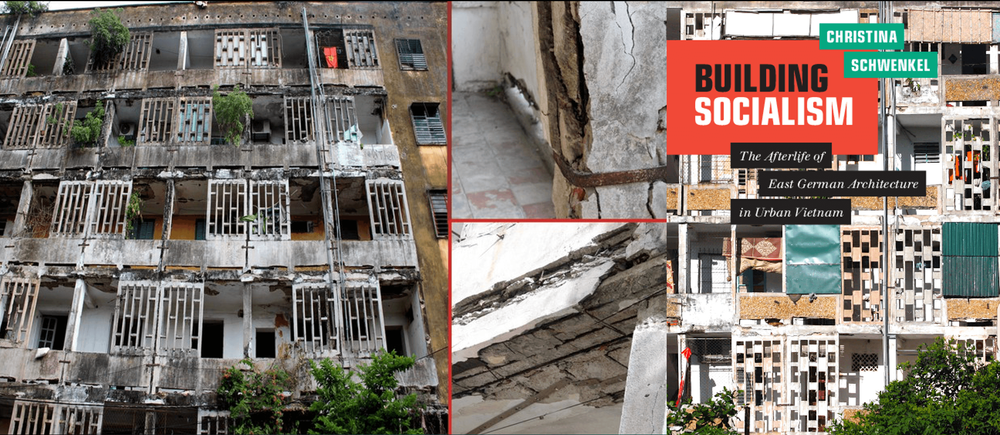
In the aftermath of war, cities often become laboratories for political imagination. Nowhere is this more evident than in the reconstruction of Vinh, a provincial city in north-central Vietnam that was nearly obliterated by U.S. bombing campaigns between 1964 and 1973. From the ruins of this destruction emerged an ambitious socialist experiment: the collaborative effort between the Democratic Republic of Vietnam and the German Democratic Republic (East Germany) to build a model socialist city. Christina Schwenkel’s Building Socialism (Duke University Press, 2020) situates this project at the intersection of architecture, politics, and everyday life, asking what it meant not only to construct socialism in material form, but also to live within—and beyond—it.
At its core, the book examines how architecture functioned as both a material and ideological medium of socialist internationalism. East German planners, engineers, and architects collaborated with their Vietnamese counterparts to redesign Vinh in accordance with the principles of modernist urban planning. Their shared goal was to transform a war-torn industrial town into a rational, efficient, and egalitarian urban environment—a “model socialist city” that would embody the promises of postcolonial reconstruction and socialist futurity.
Yet Schwenkel’s study moves beyond the familiar narrative of top-down planning. Drawing on extensive archival research and ethnographic fieldwork among architects, workers, and residents, she traces how these imported design ideals were reinterpreted, negotiated, and ultimately transformed in the Vietnamese context. Rather than a seamless transfer of socialist modernism from Eastern Europe to Southeast Asia, the reconstruction of Vinh reveals a complex process of translation across political, cultural, and environmental conditions.
Socialist Internationalism and the Built Environment
The collaboration between Vietnam and East Germany must be understood within the broader geopolitical framework of the Cold War. Socialist states engaged in transnational exchanges of expertise, technology, and ideology, forming networks that linked the “socialist North” with newly decolonizing nations in the Global South. Architecture and urban planning became key sites of this exchange, offering visible and durable expressions of solidarity.
In Vinh, East German assistance included not only material resources but also planning models rooted in high modernist ideals—standardized housing blocks, prefabricated construction methods, and functional zoning. These forms were intended to produce new social relations, fostering collective life and egalitarianism through the design of space itself. As such, the project exemplified what scholars have termed “high-socialist” development: a belief in the capacity of scientific planning and technological rationality to reshape society.
However, as Schwenkel demonstrates, these ideals were never simply imposed. Vietnamese planners and residents actively engaged with, adapted, and sometimes resisted these imported models. The resulting urban forms reflected not a singular socialist vision, but a hybridized architecture shaped by local practices, climatic realities, and cultural expectations.
From Utopia to Obsolescence
One of the book’s central contributions lies in its attention to temporal transformation—the “afterlife” of socialist architecture. While the reconstruction of Vinh was initially framed as a utopian project, its built environment quickly encountered unforeseen challenges. Economic constraints, maintenance issues, and shifting political priorities led to what Schwenkel describes as “unplanned obsolescence,” as housing complexes deteriorated and were repurposed over time.
The Quang Trung housing estate, a flagship project of the East German–Vietnamese collaboration, becomes a focal point for examining these processes. Initially designed as a symbol of socialist modernity, it later became a site of improvisation and adaptation, as residents modified their living spaces to meet everyday needs. This transformation highlights the gap between architectural intention and lived reality, revealing how inhabitants actively reshape the built environment in response to changing conditions.
By tracing this trajectory—from ruination to reconstruction to obsolescence—the book challenges linear narratives of progress. Instead, it presents urban space as a dynamic and contested field, where the meanings of architecture are continually reworked over time.
Ethnography, Materiality, and Everyday Life
Methodologically, Building Socialism bridges architectural history and anthropology. Schwenkel combines archival research with ethnographic engagement, foregrounding the voices and experiences of those who built and inhabited Vinh’s socialist infrastructure. This approach allows her to explore not only the physical structures of the city, but also their affective and social dimensions—how residents perceive, inhabit, and remember these spaces.
Through this lens, architecture emerges as more than a static artifact. It is a living medium through which people negotiate identity, memory, and belonging. The everyday practices of residents—altering apartments, repurposing communal spaces, or navigating decaying infrastructure—become forms of agency that reshape the meaning of socialist design.
Rethinking Modernity and Socialism
Ultimately, Schwenkel’s work invites a reconsideration of both modernity and socialism. The story of Vinh complicates conventional dichotomies between success and failure, or between ideological imposition and local resistance. Instead, it reveals a more ambiguous landscape, where aspirations for modern urban life coexist with uncertainty, adaptation, and decline.
The book argues that the ambivalent reception of modernist architecture in Vietnam reflects broader anxieties about the future of socialism itself. The built environment becomes a site where these tensions are made visible—where the promises of socialist modernity are both realized and undermined.
Contribution and Significance
Building Socialism makes a significant contribution to multiple fields, including urban studies, anthropology, architectural history, and Southeast Asian studies. By placing Vietnam at the center of transnational socialist networks, Schwenkel expands our understanding of Cold War globalization beyond the dominant focus on superpower relations. Her work highlights the importance of South–South (connections between countries like Vietnam and other postcolonial/socialist states) and East–South (socialist Eastern Europe vs postcolonial countries) exchanges, demonstrating how ideas and practices circulated across diverse socialist contexts.
Moreover, the book offers a powerful framework for analyzing the long-term trajectories of urban infrastructure. In an era of rapid urbanization and redevelopment, its insights into obsolescence, adaptation, and the social life of buildings remain highly relevant.
Conclusion
In tracing the rise and transformation of Vinh’s socialist architecture, Building Socialism reveals that cities are not merely built; they are continually remade. The collaboration between East Germany and Vietnam produced not a fixed model of socialist urbanism, but an evolving landscape shaped by history, politics, and everyday life. By attending to the afterlives of architecture, Schwenkel shows how the material remains of past visions continue to structure present experiences and future possibilities.
In this sense, the book is not only about the construction of socialism, but also about its endurance, transformation, and reinterpretation in the lived spaces of urban Vietnam.