The Hán–Nôm Heritage of Đình Chèm: Cultural Memory and the Depth of Tradition
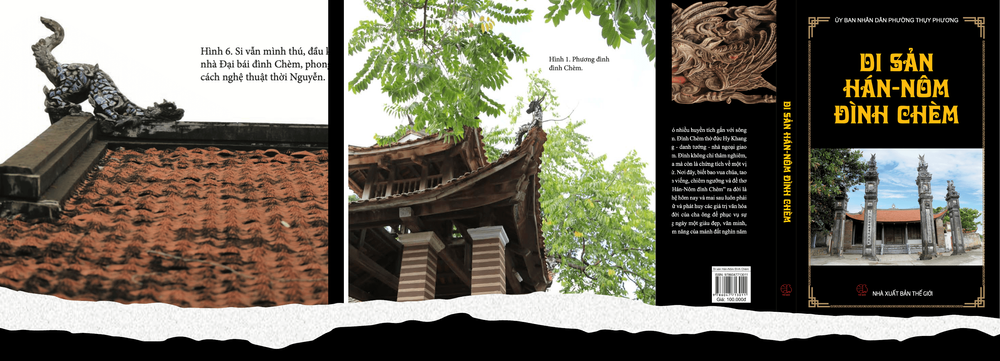
The Hán–Nôm Heritage of Đình Chèm, published by Thế Giới Publishers in 2015, is an important work of collection and research on the corpus of Hán–Nôm materials associated with Đình Chèm, one of the oldest historical sites in Hanoi. The project was carried out under the direction of the People’s Committee of Thụy Phương Ward, with Dr. Trần Trọng Dương serving as chief editor.
Rather than simply introducing a historical site, the book seeks to recover the deeper cultural memory of a community. It situates Đình Chèm within a broad network of history, belief, and textual tradition. In this context, Hán and Nôm scripts are not merely tools of record, but vessels through which collective memory has been preserved across centuries.
Chèm Village, the old vernacular name of what is now Thụy Phương Ward, is an ancient Vietnamese settlement closely tied to the Red River and the historic Từ Liêm region. Located at the confluence of major waterways, Đình Chèm once stood at a point of active exchange, both commercial and cultural, within the Thăng Long area. With its classical architecture and distinctive geographic setting, the đình is not only a physical structure, but a space where multiple layers of historical and cultural memory have accumulated over time.
At the center of the book’s documentary system is the figure of Hy Khang Heavenly King Lý Ông Trọng, a character that is at once historical and legendary, often regarded as one of the earliest military leaders and diplomats of Vietnam. Notably, the cult of Lý Ông Trọng extends beyond the local sphere and appears in numerous classical Chinese texts, forming a transregional textual network that spans thousands of years. Records from works such as the Records of the Grand Historian, the Book of the Former Han, and the Zizhi Tongjian reveal how this figure circulated and transformed across the East Asian cultural sphere.
One of the book’s most significant contributions is its assembly of a Hán–Nôm textual corpus with an exceptionally long historical span, from around the 2nd century BCE to the early 20th century. Few sites in Vietnam can be studied through such a continuous textual record. This allows readers not only to approach a historical narrative but also to trace how that narrative has been recorded, reinterpreted, and restructured over time. In this sense, the texts are not simply sources of information, but living evidence of how collective memory is formed.
The book is organized around three interwoven layers of sources. The first consists of classical Vietnamese texts from the 14th to 19th centuries, including Đại Việt sử ký toàn thư, Lĩnh Nam chích quái, and Việt điện u linh, along with historical verse narratives and poetic compositions that shaped the literary and historical image of Lý Ông Trọng. The second layer focuses on Hán–Nôm materials preserved directly at Đình Chèm itself—imperial edicts, horizontal plaques, parallel couplets, stone inscriptions, classical Chinese poems, and ritual texts—inscribed on materials such as wood, stone, bronze, and paper. These sources provide a direct view into the religious life and ritual practices of the local community. The third layer draws on Chinese historical records related to the cult of Lý Ông Trọng, expanding the scope beyond Vietnam and highlighting patterns of cultural interaction in the region.
Under the editorial leadership of Trần Trọng Dương, the work goes beyond collection and applies rigorous methods from textual criticism and historical philology: comparing variant versions, correcting original texts, providing Sino-Vietnamese readings, translating meanings, and adding annotations. In some cases, the texts are also rendered into more accessible literary forms to reach contemporary readers. At the same time, the editorial team identifies and corrects certain long-standing inaccuracies, contributing to the scholarly reliability of the material.
A key idea running through the book is the role of writing as a foundation of cultural identity. The Hán–Nôm texts at Đình Chèm do more than record history; they preserve ritual systems, aesthetic values, modes of thought, and the memory of a community across generations. From this perspective, writing itself becomes a form of heritage—a “living heritage” sustained through acts of reading, interpretation, and transmission.
Published at a time when local authorities were actively promoting the preservation and activation of cultural heritage, the book carries not only academic value but also strong social meaning. It serves as a reminder of the responsibility to protect and sustain traditional cultural values as a foundation for long-term development.
Taken as a whole, the Hán–Nôm Heritage of Đình Chèm offers a compelling way of understanding historical sites: not merely as physical locations, but as textual ecosystems in which history, belief, and memory are layered, reinterpreted, and carried forward over time. Within this ecosystem, Đình Chèm does not belong solely to the past, but continues to exist, and to matter, in the present and into the future.
Explore the book on our Digitizing Vietnam platform here.