Digitizing Việt Nam at AAS 2026
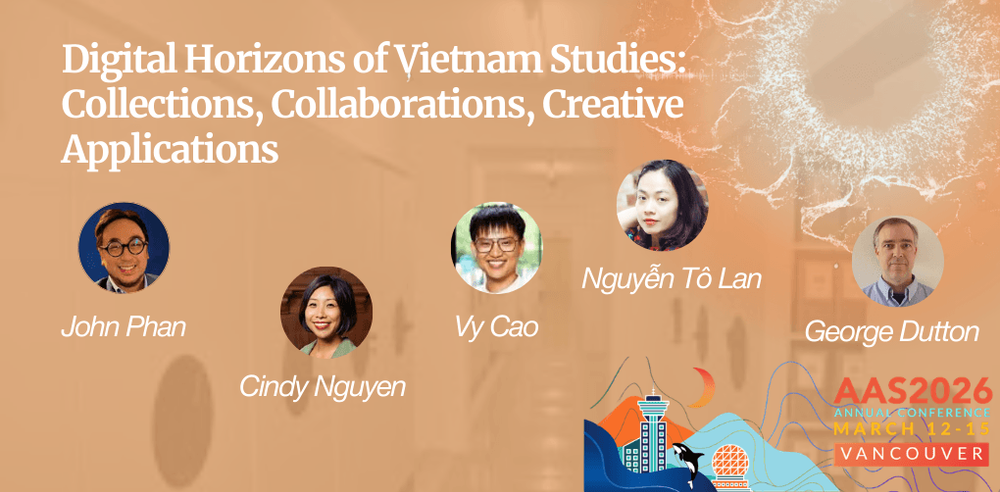
Session 319: Digital Horizons of Vietnam Studies
Friday, March 13, 2026 | 11:00 AM – 12:30 PM PDT
Vancouver Convention Centre (VCC), Room 115
At the 2026 Association for Asian Studies Annual Conference in Vancouver, Digitizing Việt Nam will stand at the center of a major roundtable on digital scholarship in the field: Session 319: Digital Horizons of Vietnam Studies: Collections, Collaborations, Creative Applications.
Organized and chaired by Cindy Nguyen (UCLA), the roundtable brings together leading scholars working across institutions and continents to reflect on how Vietnam Studies is being reshaped through digital collections, transnational collaboration, and experimental methodologies.
Over the past decades, Vietnam Studies has undergone profound transformation—expanding interdisciplinarily, incorporating multilingual scholarship, and deepening engagement with Vietnam and its global diaspora. As the field marks fifty years since the end of the Vietnam War/Second Indochina War/American War, it is also entering a new phase defined by digital infrastructures and public-facing scholarship.
This roundtable will focus on specific case studies and live demonstrations, emphasizing collaboration, methodological innovation, and training the next generation of scholars.
Featured Projects
- George Dutton (UCLA) will discuss the digitization of the Đại Nam Nhất Thống Chí gazetteer, addressing key challenges in OCR for historical Vietnamese and Sino-Nôm materials, textual annotation strategies, and ensuring cross-disciplinary usability of large textual corpora.
- Nguyễn Tô Lan (Vietnam Academy of Social Sciences) will present the Vietnam Buddhist Resource Digital Repository, a scholar-led initiative dedicated to collecting, digitizing, and providing free global access to resources on Vietnamese Buddhism, with particular emphasis on Sino-Nôm texts. The project models sustainable, open-access infrastructure rooted in scholarly collaboration.
- Vy Cao (Luxembourg Centre for Contemporary and Digital History) will introduce the DISTAM-funded “RAG’it” project, applying Retrieval-Augmented Generation techniques to trace the development of neologisms across early twentieth-century Vietnamese periodicals such as Nam Phong and Tân Việt. The project demonstrates how AI tools can illuminate intellectual change within print culture.
- Cindy Nguyen (UCLA) will present her “Social Worlds” project, drawing from a colonial multilingual Vietnamese encyclopedia to show how combining close reading with computational methods—such as vector space modeling—allows researchers and students to rethink interpretation as a core scholarly act.
- John Phan (Columbia University) will present Digitizing Vietnam, a collaboration between Columbia University and Fulbright University Vietnam. The initiative is developing a digital hub for Vietnam Studies that integrates digitized collections, bibliographic tools, and pedagogical materials, expanding global access to Vietnamese historical resources.
Rather than traditional formal papers, the session is structured around short presentations and demonstrations, prioritizing engaged discussion, collective brainstorming, and the formation of new collaborations.
Additional Highlights in Vietnam Studies at AAS 2026
- Roundtable Tribute: The Life and Work of Gerard Sasges
Scheduled for Friday morning at 9:00 AM, this roundtable will honor the esteemed historian’s intellectual legacy. Appreciation is extended to Peter Zinoman for organizing this tribute at the eleventh hour.
VSG-Sponsored Panel (Session 1110):
Constructing Socialism: State-Building and Governance in the Democratic Republic of Vietnam, 1954–1975
Taking place Sunday morning, this panel will revisit foundational questions about governance and socialist state formation in the DRV. Thanks are due to the Vietnam Studies Group (VSG) selection committee and organizers for advancing this important conversation.Session 621: Knowledge at the Margins
Scheduled for Saturday morning, this panel—composed primarily of scholars from Southwest Jiaotong University (PRC)—will examine reading communities and the social life of texts in nineteenth-century Vietnam. It may represent one of the first Vietnam-focused AAS panels centered on scholars from a single Chinese institution, marking an important moment in the internationalization of Vietnam Studies. Another panel with participants largely from France further reflects the growing global scope of the field.- Session 114: Archives and Data in Dialogue (Thursday evening), organized by French early-career scholars, exploring multilingual archives, postcolonial methodology, and digital research practices in Vietnamese Studies.
As AAS 2026 approaches, Vietnam Studies will demonstrate both intellectual continuity and methodological transformation. For Digitizing Việt Nam, Session 319 will serve not only as a presentation platform but as a space to advance collaborative digital infrastructure—shaping how Vietnamese history, texts, and ideas will be accessed, studied, and taught in the years to come.
👉 Find the complete list of sessions and abstracts here.