Reclaiming Creation, Interpretation, and the Humanistic Imagination in the Age of Artificial Intelligence
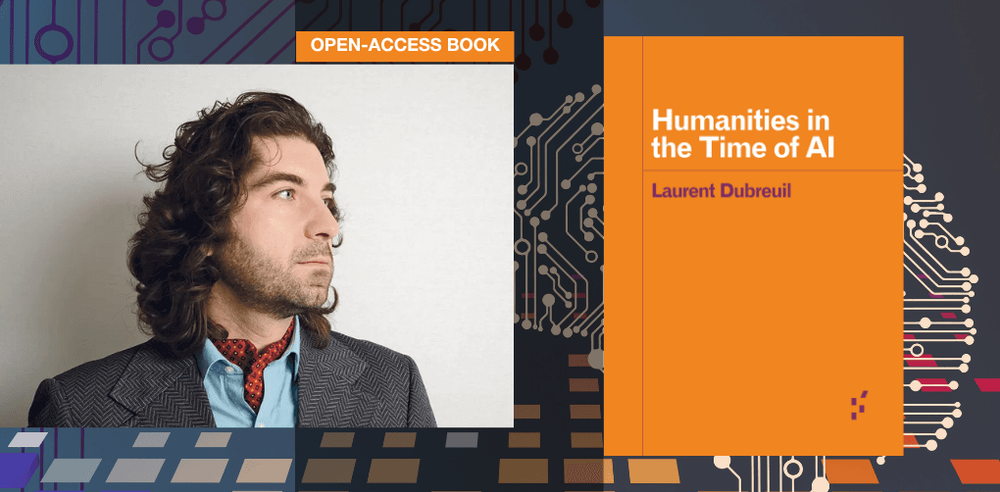
The rapid rise of artificial intelligence has generated a familiar question: will machines eventually replace human intellectual labor? In Humanities in the Time of AI, Laurent Dubreuil offers a provocative answer: the greatest danger posed by artificial intelligence is not that machines will become too human, but that humans may have misunderstood what makes humanistic thinking valuable in the first place. Rather than defending the humanities through a simple opposition between humans and machines, Dubreuil argues that AI provides an opportunity to rediscover the deepest purposes of humanistic inquiry: interpretation, creation, imagination, and the exploration of possibilities beyond what is already known.
Written as a series of reflections on artificial intelligence, knowledge, language, and scholarship, the book rejects both technological pessimism and technological enthusiasm. Dubreuil describes his position as one of “paradoxical optimism”: AI represents a profound challenge to traditional forms of scholarship, but precisely because of this challenge, it reveals what the humanities should become. If humanistic research is understood merely as the production of summaries, descriptions, classifications, translations, and standardized arguments, then AI will eventually perform these tasks more efficiently. However, Dubreuil argues that these activities were never the ultimate purpose of the humanities. Their deeper mission lies in the creation of meaning, the interpretation of complexity, and the encounter with the unknown.
AI as a Mirror of Humanity
One of the book’s central arguments is that artificial intelligence should not be understood as something entirely external to humanity. In the chapter “AI Is Us,” Dubreuil challenges the tendency to imagine AI as an alien intelligence emerging outside human culture. AI is instead a product of human history, built from human knowledge, language, technological systems, and social structures. Large language models are trained on enormous collections of human-created texts, images, sounds, and cultural artifacts; they are therefore reflections of humanity’s accumulated intellectual production.
At the same time, the relationship between humans and AI is not one-directional. Humans create AI, but AI also transforms human behavior, imagination, and intellectual practices. Through interaction with computerized systems, people modify how they write, search, communicate, and produce knowledge. For Dubreuil, the boundary between humans and machines is therefore not a simple division between two separate entities. Rather, AI represents a new technological environment through which humanity encounters itself.
This argument allows Dubreuil to move beyond two common positions. The first imagines AI as a threatening external force that must be resisted. The second imagines AI as a neutral tool that will simply enhance human abilities without changing them. Instead, Dubreuil presents AI as a mirror: it reflects both human achievements and the limitations of how humans have come to understand intelligence.
We Are Not AI: The Difference Between Computation and Creation
Although Dubreuil emphasizes humanity’s deep relationship with AI, he insists that humans and machines are not identical. In “We Are Not AI,” he argues that the difference cannot be reduced only to familiar claims that humans possess emotions, consciousness, or moral awareness. While these distinctions may be important, Dubreuil argues that they do not fully explain the uniqueness of human thought.
Instead, he focuses on the structure of AI itself. Generative AI systems are fundamentally dependent on existing data. Their outputs emerge through statistical relationships, probability, and recombination of previous materials. They are powerful systems of pattern recognition and generation, but their creativity remains fundamentally tied to what has already been produced.
Dubreuil identifies several characteristics of generative AI:
- it is anchored in the past because it learns from existing corpora;
- it favors probable and common patterns;
- it produces impersonal expressions rather than singular voices;
- it lacks an overarching intellectual trajectory;
- it operates algorithmically;
- it does not itself produce meaning.
The final point is particularly important. For Dubreuil, a text does not contain meaning in itself. Meaning emerges through interpretation: through the encounter between language, experience, context, and the reader’s mind. AI can generate language, but it does not experience significance in the humanistic sense.
This distinction explains why AI can imitate the style of an author without becoming that author, summarize a philosophical argument without engaging philosophically, or reproduce patterns of artistic expression without necessarily creating something genuinely new.
Beyond the Myth of Human Essence
A major strength of Dubreuil’s argument is his refusal to defend the humanities through a simplistic idea of “human uniqueness.” Many discussions of AI rely on the claim that humans possess an essential quality—creativity, consciousness, or spirit—that machines can never possess. Dubreuil finds this approach insufficient.
In “Naming the Human(ities),” he examines the very meaning of the term “humanities.” He argues that the humanities are not defined by a fixed category called “the human.” Different intellectual traditions have named this field differently: Geisteswissenschaften (sciences of the mind), lettres (letters), ré n wén (人文, human culture), and artes liberales (liberal arts). Each term highlights a different dimension of humanistic inquiry.
Rather than understanding humanity as a biological essence, Dubreuil proposes understanding it as a process of becoming. To be human is not simply to possess certain characteristics; it is to participate in language, culture, interpretation, and self-transformation.
This argument is especially significant in the context of AI. The question is not whether machines can acquire a predefined human essence. Instead, the question is how humans continually redefine themselves through encounters with new forms of knowledge, technology, and otherness.
However, Dubreuil also acknowledges the dangers of defining “the human” too narrowly. Throughout history, claims about human exceptionalism have often been used to exclude others, including Indigenous peoples, racialized communities, and nonhuman beings. Therefore, the humanities must constantly examine their own categories and assumptions.
From Description to Interpretation
Perhaps the most practical argument of the book appears in “Descriptions and Interpretations,” where Dubreuil critiques one of the humanities’ most persistent weaknesses: the tendency to confuse information with knowledge.
Dubreuil argues that much academic work has become overly focused on description:
- summarizing previous scholarship,
- documenting events,
- presenting background information,
- organizing existing facts.
While description is necessary, it becomes meaningful only when connected to interpretation. A list of historical events does not explain their significance. A biography does not illuminate an artwork unless it contributes to understanding the work itself. A literary summary does not replace literary criticism.
This distinction becomes increasingly urgent in the age of AI. Generative AI excels at producing organized descriptions and summaries. If scholars define their work primarily through these activities, they compete directly with machines in an area where machines are likely to succeed.
For Dubreuil, the humanities should instead focus on interpretation: asking why something matters, how meanings are produced, and what possibilities emerge from encounters with texts, objects, and histories.
The Humanities Beyond Disciplines
In “Perspectives and Disciplines,” Dubreuil further develops his argument by distinguishing between academic disciplines and the humanistic perspective. The humanities are not simply a collection of departments—history, literature, philosophy, art history—but a particular way of thinking characterized by dialogue, openness, ambiguity, and the continuous production of meaning.
This perspective is not limited exclusively to the humanities. Scientists can engage in humanistic thinking when they critically examine their assumptions and participate in intellectual dialogue. Likewise, scholars in the humanities may abandon humanistic inquiry if they merely reproduce established frameworks.
Dubreuil therefore rejects a simplistic opposition between science and humanities. The issue is not whether knowledge is scientific or humanistic, quantitative or qualitative. The deeper difference concerns whether knowledge seeks only predictable results or remains open to interpretation, exceptions, and transformation.
A New Future for the Humanities
The concluding chapter, “An Opening,” brings together Dubreuil’s vision for the future of scholarship. He argues that the humanities should not attempt to compete with AI by becoming better machines. Instead, they should emphasize what AI cannot replace: exploration, speculation, interpretation, and the creation of new meanings.
The humanities, according to Dubreuil, are fundamentally concerned with the relationship between norms and exceptions. They study not only what is predictable but also what interrupts prediction: unusual experiences, singular works, unexpected ideas, and creative transformations.
He rejects the idea that the future of the humanities requires a simple program of reform or a new technological specialization. Rather, he calls for a more experimental and open-ended humanities—one willing to engage with science, technology, and diverse intellectual traditions without reducing itself to any single method or ideology.
What remains
Dubreuil’s greatest contribution is that he reframes the AI debate. Instead of asking whether machines will replace humans, he asks a more fundamental question: what kinds of human activities deserve to remain human?
His argument is particularly persuasive in showing that AI exposes weaknesses already present within academia. When scholarship becomes a process of producing predictable summaries and formulaic arguments, it begins to resemble the very systems that AI can automate. The challenge of AI therefore becomes an opportunity for scholars to reclaim intellectual ambition.
However, the book also raises questions. Not all valuable scholarship consists of radical creation or intellectual breakthroughs. Much humanistic work depends on careful documentation, preservation, translation, editing, and accumulation of knowledge. These practices may appear descriptive but remain essential foundations for interpretation.
Nevertheless, Dubreuil’s broader point remains compelling: the humanities should not measure their value by competing with machines at producing information. Their value lies in transforming information into understanding. AI does not threaten the humanities because machines are becoming human. It threatens them because humans have sometimes reduced their own intellectual practices to activities that machines can reproduce. As Dubreuil concludes, the time of AI is both a closing and an opening: a moment in which the humanities must decide not whether they can survive alongside machines, but what kind of thinking they wish to preserve and create.
Read the digital, open-access version of Laurent Dubreuil's Humanities in the Age of AI here.