Where does “liền anh liền chị” come from?
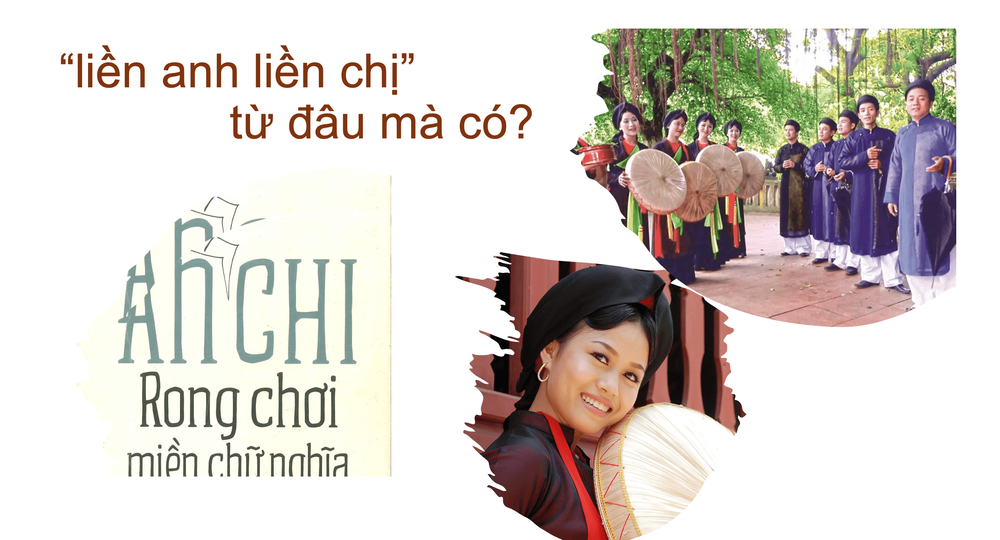
In his book Rong chơi miền chữ nghĩa (Volume 1), An Chi offers a thorough etymological and pragmatic study to explain the origin of the element liền in the expressions liền anh and liền chị in Quan họ folk singing. Starting from a seemingly familiar yet insufficiently explained linguistic phenomenon, the author approaches the issue through three dimensions—grammar, phonology, and semantics—then expands the discussion through dialectal comparison and historical linguistics to arrive at a well-grounded conclusion.
From a grammatical perspective, the author identifies liền anh and liền chị as nominal phrases, in which liền functions as the head. This leads to an interesting paradox: in modern standard Vietnamese, liền is only recognized as an adjective or an adverb (e.g., “immediately,” “adjacent”), but not as a noun. From this, the author hypothesizes that liền in this context is an archaic word that has undergone semantic bleaching, surviving only in limited domains such as Quan họ or certain regional dialects.
Phonologically, liền is identified as an older Sino-Vietnamese reading of the character 聯 (possibly also related to 連), corresponding to the modern Sino-Vietnamese reading liên. The tonal shift from low-falling (huyền) to level tone is common in Sino-Vietnamese evolution, as seen in examples such as: là (羅) → la, làn (瀾) → lan, lầu (樓) → lâu, liềm (鎌) → liêm. Additionally, liền has a variant form liễn, attested in several historical dictionaries. These variants indicate that liền is not an isolated form but part of a systematic pattern of phonological variation.
Semantically, the author traces liền back to the original meanings of 聯 in Chinese, including “series,” “sequence,” “connection,” and especially “association” or “group.” The sense of “bundle” or “set” is preserved in dialectal usage: in Nghệ-Tĩnh, liền trầu means a bundle of betel leaves; in southern dialects, liễn trầu or liễn bát refers to a stack or bundle; in literary Vietnamese, liên (聯) denotes a couplet (a pair of verses), such as liên đề or liên thực in regulated Tang poetry. From the meaning “association” or “group,” the author explains that liền in Quan họ originally referred to a group of singers—a Quan họ ensemble.
In Quan họ practice, liền anh is the term used by female groups to refer to male groups, while liền chị is used by male groups to refer to female groups. The term liền em is a humble self-reference used by an individual representing their group. Thus, originally, these expressions referred not to individuals but to entire groups. Over time, as liền lost its independent meaning, these expressions came to denote individual members, and liền became a bound morpheme carrying a sense of relational hierarchy.
To strengthen the argument, the author compares liền with đàn, a common morpheme in modern Vietnamese. Originally referring to a group of animals (đàn bò, đàn chim), đàn developed two key functions: indicating gender (đàn ông, đàn bà) and indicating hierarchy (đàn anh, đàn chị, đàn em). Similarly, liền once had parallel uses: liền ông, liền bà (equivalent to “men,” “women”) and liền anh, liền chị, liền em. Traces of this usage still survive in dialects, especially in the Chùa Hương region, where people still say liền ông, liền bà. This is even reflected in the folk rhyme: “Thả đỉa ba ba, chớ bắt liền bà, phải tội liền ông…”, demonstrating the living presence of this linguistic form in folk culture.
The author further expands the analysis to other dialects, particularly Bình Trị Thiên, where variants such as nên ông, nên bà appear, alongside related forms like đỉnh, linh, and ninh. This leads to the hypothesis that liền, đàn, and nên share a common origin. To support this, the author identifies two key phonological patterns. First is the correspondence between the rhymes -iên and -ên, illustrated by pairs such as: biên (邊) ~ bên, điện (殿) ~ đền, hiên (蜆) ~ hến, phiên (藩) ~ phên, quyến (眷) ~ quyến. Second is the alternation between initial consonants l- and n-, as seen in Sino-Vietnamese pairs such as: lạm (濫) ~ nạm, loại (類) ~ nòi, loan (巒) ~ non, lỗ (魯) ~ nỏ, lũng (壟) ~ nổng, and noãn (卵), which may also be read as loãn. These patterns support the idea that liền and nên are phonological variants of the same root.
From these analyses, the author concludes that liền in liền anh, liền chị originates from the character 聯 meaning “association” or “group,” originally referring to Quan họ collectives before shifting to denote individuals and eventually functioning as a relational marker. At the same time, liền is etymologically and semantically connected to đàn and nên, reflecting both dialectal diversity and historical linguistic development in Vietnamese.
Ultimately, the article not only clarifies the origin of a specific linguistic element but also demonstrates a broader historical-linguistic methodology—combining lexicography, dialectology, phonology, and cultural context. It reveals that what may appear as “natural” language usage is in fact the result of a long process of transformation, deeply intertwined with the social and cultural life of Vietnamese communities.
Read Rong chơi miền chữ nghĩa (Volume 1) by An Chi on the Digitizing Vietnam platform:
https://www.digitizingvietnam.com/en/our-collections/tinh-hoa-van-hoc-va-ngon-ngu-viet-nam/rong-choi-mien-chu-nghia-1