Listening to a Crisis: Christina Schwenkel’s Sonic Socialism
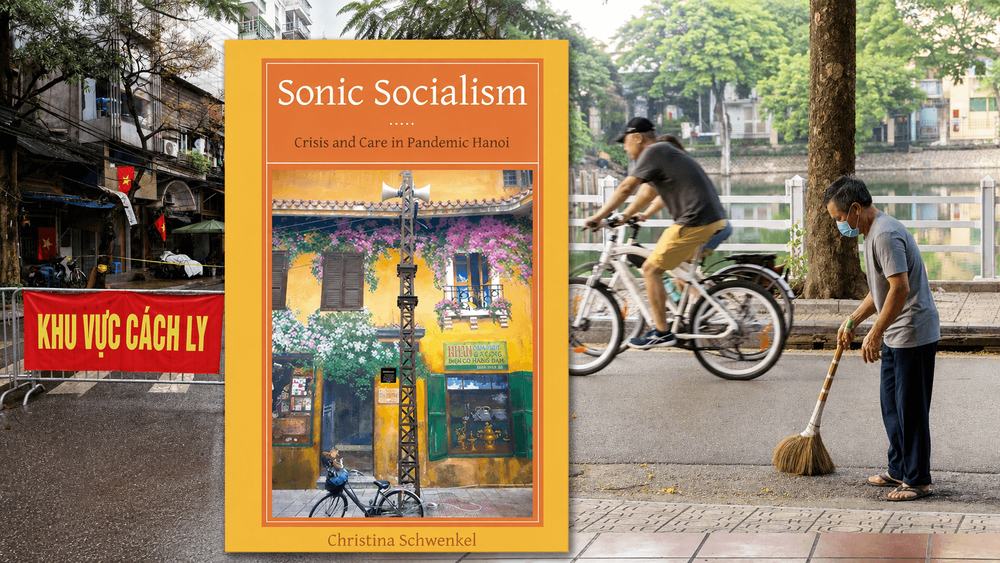
What did the COVID-19 pandemic sound like?
For many people, it sounded like absence: deserted streets, closed businesses, and the sudden quiet left by suspended routines. In Hanoi, however, the emergency also had an insistent public voice. Neighborhood loudspeakers broadcast health instructions. Phones announced incoming government messages. Songs and videos transformed preventive measures into memorable rhythms. Behind apartment doors, residents listened for signs of danger, reassurance, and ordinary life.
In Sonic Socialism: Crisis and Care in Pandemic Hanoi, anthropologist Christina Schwenkel makes these sounds central to our understanding of the pandemic. Published by the University of California Press in November 2025, the 226-page book examines how sound helped organize Vietnam’s response during the first year of COVID-19. It is also available as a free digital edition through the press’s Luminos open-access program. The publication itself is multimedia: alongside thirty black-and-white illustrations, it includes nine audio files and six videos that allow readers to encounter some of the sonic material on which Schwenkel’s analysis rests.
Hearing what visual accounts overlook
Public representations of the pandemic were overwhelmingly visual. News reports showed infection maps, masked faces, hospital wards, empty airports, and graphs of rising cases. Schwenkel asks what becomes perceptible when we turn from looking to listening.
Her answer is that sound was not merely a background feature of pandemic life. It was part of the infrastructure through which the emergency was governed and experienced. Public announcements, mobile-phone alerts, health videos, music, voices, noise, and silence communicated changing levels of risk. They influenced how residents used public space, understood their responsibilities, and related to one another.
Schwenkel calls this process “sonic governance.” The term describes the state’s use of acoustic and media technologies to circulate information, coordinate conduct, and encourage collective action. Yet the concept is not reducible to propaganda or surveillance. Sound could impose discipline, but it could also deliver practical knowledge, reassurance, and a sense that people were facing the emergency together. The same loudspeaker might therefore be heard as intrusive by one listener and protective by another.
This tension between care and control is one of the book’s most important themes. Rather than placing the two in separate categories, Schwenkel shows how they could operate through the same institutions and technologies.
Why Vietnam’s early response matters
The book concentrates on 2020, when Vietnam’s initial containment of the virus attracted international attention. According to the World Bank, the country recorded only 35 COVID-19 deaths that year while maintaining positive GDP growth of 2.9 percent. The organization described Vietnam’s early response as one of the world’s most effective.
These early results should not be confused with the country’s experience throughout the entire pandemic. Vietnam faced much larger outbreaks and a substantial death toll after more transmissible variants arrived. Schwenkel’s subject is specifically the first pandemic year and the forms of organization, communication, and social cooperation that shaped it.
Official assessments support the importance she gives to communication. A joint report from Vietnam’s Ministry of Health and the World Health Organization credited the early activation of a coordinated national response—including surveillance, testing, clinical management, infection control, and risk communication—with helping the country contain COVID-19 in 2020.
Public-health information moved through an unusually broad media environment. Digital alerts and social platforms operated alongside television, popular music, and longstanding neighborhood loudspeaker systems. A World Bank study notes that the Ministry of Health sent repeated mobile notifications during the April 2020 lockdown and promoted preventive behavior through the internationally successful song and dance video “Ghen Cô Vy.”
Schwenkel’s distinctive contribution is to examine how this communication was actually heard and lived—not simply how it was designed by authorities.
From disaster response to “sonic socialism”
The book’s title names a political and ethical argument. For Schwenkel, “sonic socialism” refers to the ways sound drew people into relationships of collective responsibility while also making state power present in everyday life.
Vietnam’s response emerged from specific historical circumstances: a socialist political system, earlier encounters with SARS and avian influenza, established practices of neighborhood mobilization, and memories of war and reconstruction. Schwenkel connects the pandemic response to what she calls “disaster socialism”—a form of crisis governance that directs care through public infrastructure and collective mobilization rather than leaving emergency preparedness primarily to markets or private individuals.
The concept does not present pandemic Hanoi as a seamless community. Collective solidarity coexisted with inequality, disagreement, exhaustion, and dissent. Nor were all residents equally protected. The book repeatedly brings readers back to people whose labor made collective safety possible while exposing them to economic or physical vulnerability: security guards, domestic workers, delivery drivers, and migrants.
These figures appear between the book’s principal sections, which follow three phases of the emergency: quarantine, understood in relation to state care; lockdown, associated with practices of self-care; and social distancing, examined as a field of mutual care. This structure shifts attention between public policy and intimate experience. It asks not only what the state announced, but also who listened, who worked, who was able to remain at home, and whose movement continued to sustain urban life. The complete book and its chapter structure can be consulted through its open-access record on JSTOR.
An ethnography conducted from inside the emergency
Sonic Socialism is also a methodological experiment. Schwenkel was living in Hanoi during the pandemic’s first year, when conventional ethnographic fieldwork became difficult or impossible. In response, she developed what she calls “soundwork”: an immersive form of research based on listening, recording, walking, bodily experience, and attention to changing acoustic environments.
The result is a sensory autoethnography. Schwenkel does not write as an observer positioned safely outside the crisis. Her own uncertainty, movement, and dependence on systems of care form part of the evidence. Sound becomes both her object of study and a method for understanding an event unfolding around her.
This approach raises questions that extend well beyond Vietnam. How should anthropologists conduct research when proximity may endanger other people? What kinds of knowledge become possible when observation is restricted? Can listening produce a more careful—and more caring—form of ethnography?
Schwenkel is particularly well placed to pursue these questions. She is a professor of anthropology at the University of California, Riverside, whose long-term research has examined Vietnam, infrastructure, historical memory, reconstruction, and urban sensory life. Her previous books include The American War in Contemporary Vietnam and the award-winning Building Socialism: The Afterlife of East German Architecture in Urban Vietnam. UCR describes her wider research as concerned with how embodied sensations shape people’s experience of cities and how those sensations are organized and disciplined.
A book about listening as a social relationship
The broader achievement of Sonic Socialism is to make listening politically significant. Emergency communication does more than transmit facts. It establishes relationships among authorities, technologies, neighborhoods, and bodies. It tells people when to become alert, whom to trust, what obligations they have to strangers, and whose welfare counts as a collective concern.
Schwenkel does not ask readers simply to admire Vietnam’s early response or to adopt its institutions elsewhere. Instead, she invites us to reconsider the assumptions through which crises are usually interpreted. Public sound can be coercive, but it can also connect. State infrastructure can regulate, but it can also care. Individual precaution may protect the self, but it depends on networks of labor and mutual responsibility.
That argument makes Sonic Socialism more than a historical account of Hanoi in 2020. It is a study of how collective life is assembled during an emergency—and of what conventional, vision-centered accounts fail to perceive. In a world preparing for future pandemics, climate disasters, and other public crises, Schwenkel leaves readers with a deceptively simple proposition: preparedness depends not only on whether institutions can make themselves heard, but also on how societies learn to listen.