Printing, Publishing, and the Making of Modern Vietnam: Introducing BULAC's New Exhibition
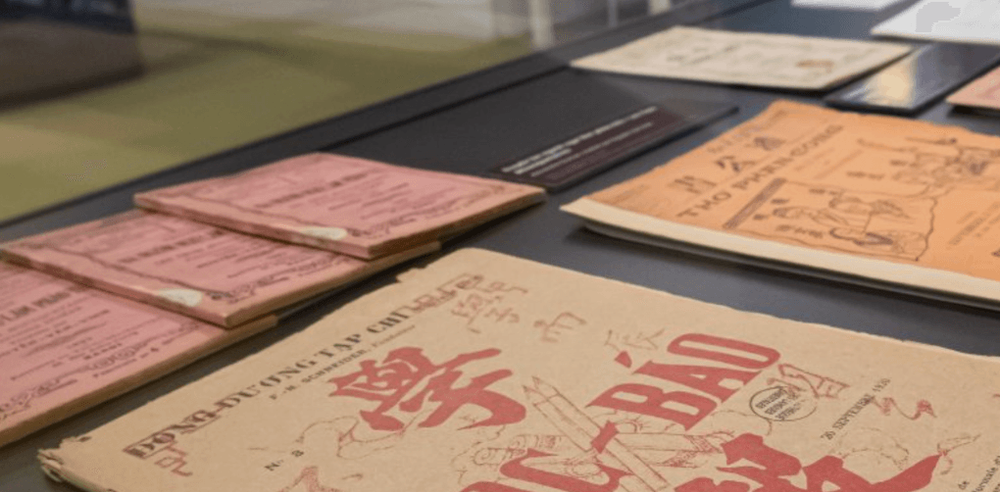
The BULAC exhibition Imprimer, éditer, illustrer : la modernité typographique et graphique au Vietnam (1860–1945) (Printing, Editing, Illustrating: Typographic and Graphic Modernity in Vietnam (1860–1945)) presents a compelling exploration of how printing, publishing, and graphic design contributed to the emergence of modern Vietnamese cultural life. Through rare books, newspapers, printing materials, and visual archives, the exhibition traces a period of profound transformation in which Vietnamese traditions of textual production encountered new technologies and new forms of readership. Rather than depicting modernity as a simple transfer of Western techniques, the exhibition reveals a more complex process of adaptation, circulation, and reinvention involving Vietnamese, Chinese, Southeast Asian, and European influences.
The exhibition revisits the foundations of Vietnamese printing culture through xylography (woodblock printing). Wooden printing blocks and popular images from the collections of the École française d’Extrême-Orient illustrate the craftsmanship behind traditional printing practices. The exhibition highlights Đông Hồ popular prints, explaining how images were produced through several stages: applying ink onto carved wooden blocks, stamping the paper, and adding colors by hand. It also emphasizes the diversity of regional styles, including Đông Hồ, Kim Hoàng, Hàng Trống, and Làng Sình, showing that printing was not merely a technical process but also a form of local artistic expression.
One of the exhibition’s most insightful contributions is its attention to the circulation networks behind Vietnamese texts. The display of Nam kinh Bắc kinh truyện (L’histoire de Nam Kinh Bắc Kinh), a nineteenth-century Nôm verse novel, demonstrates how Vietnamese literary works were connected to wider East Asian printing networks. Revised by the scholar Duy Minh thị, the work was printed by the Jin wen tang (近文堂) press in Foshan, Guangdong, before being distributed in Saigon through the Quảng Thịnh Nam bookstore. This example challenges the idea of Vietnamese publishing as an isolated national development and instead reveals a dynamic regional ecosystem of textual exchange.
The transition from traditional printing to modern publishing is illustrated through the rise of lithography, typography, and quốc-ngữ. Works such as Chữ Nôm An Nam : petit dictionnaire pratique à l’usage des élèves du cours d’annamite (1877) demonstrate how lithography supported new educational and linguistic projects, while materials related to Petrus Trương Vĩnh Ký’s language manuals show the growing importance of printed resources for language learning and translation. The exhibition highlights how quốc-ngữ, the romanized Vietnamese writing system, became closely connected with the expansion of Vietnamese-language publishing and the creation of new reading communities.
A particularly significant section focuses on the birth of modern Vietnamese journalism. The display of Gia Định báo (1865–1909), recognized as the first newspaper printed in quốc-ngữ, illustrates the transformation of print into a medium for public communication. Published in Saigon from 1865, the newspaper included official texts as well as articles on history, morality, and current affairs, marking an important stage in the formation of a Vietnamese-language public sphere.
By the early twentieth century, the exhibition shows how Vietnamese publishers increasingly shaped the literary and cultural landscape. Figures such as Nguyễn Văn Vĩnh played an important role in developing modern publishing practices in northern Vietnam through enterprises such as the Imprimerie Express and Trung Bắc Tân Văn. The expansion of publishing houses also created new markets for literature, education, entertainment, and commercial culture.
The exhibition’s final sections demonstrate how publishing became a vehicle for imagining modern identities. Anh Thơ’s poetry collection Bức tranh quê (Le tableau de la campagne, 1941), published by Đời Nay, represents a new relationship between books and readers: publishers produced both affordable editions for general audiences and special editions for collectors, transforming books into cultural objects. Similarly, Vui chơi ca múa: sách hát đầu tiên của Hoa Xuân (1939), illustrated by Trịnh Hữu Ngọc, reflects the emergence of children’s literature and new forms of illustrated publishing during the 1930s and 1940s.
Overall, Imprimer, éditer, illustrer offers an important reflection on Vietnamese modernity through the lens of print culture. Its central insight is that modernity was not only expressed through political movements or intellectual debates but was also produced through everyday encounters with books, newspapers, images, and new reading practices. By bringing together printing tools, literary works, newspapers, and graphic materials, the exhibition reveals the material foundations behind the transformation of Vietnamese society between 1860 and 1945.
View the online exhibition on the BINA platform of BULAC.