Signs and Signals from Vietnam: Essays on Contemporary Art
How might we write a history of contemporary Vietnamese art without reducing it to war, national division, or the familiar opposition between artists inside Vietnam and those in the diaspora?
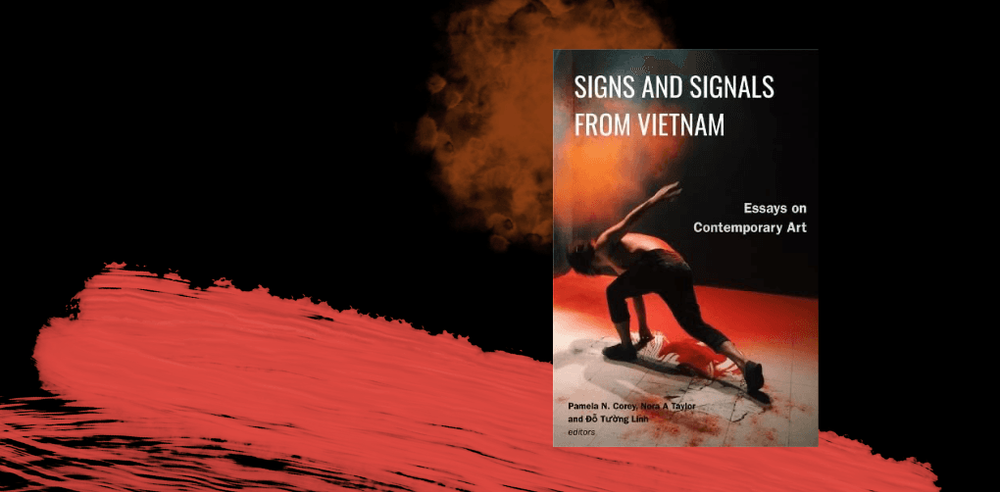
A newly published collection, Signs and Signals from Vietnam: Essays on Contemporary Art, takes up precisely this challenge. Published by NUS Press in 2026, the volume is edited by art historians Pamela N. Corey and Nora A. Taylor, together with curator and researcher Đỗ Tường Linh. Bringing together artists, curators, researchers, and scholars working from different generations and positions, the book offers a multifaceted examination of artistic practice in and from Vietnam over the past three decades.
Rather than attempting to construct a single, definitive history of Vietnamese contemporary art, Signs and Signals from Vietnam embraces multiplicity. Its essays consider how artists have worked through language, archives, performance, narrative, memory, and other forms of experimentation to make sense of histories and experiences that are not always visible in conventional accounts of Vietnam.
In doing so, the collection asks readers to reconsider not only what contemporary Vietnamese art looks like, but also how its histories should be written, who participates in writing them, and which frameworks are adequate for understanding them.
Beyond the familiar narratives of Vietnamese art
The last three decades have witnessed a remarkable transformation in Vietnam's artistic landscape. Artists from Vietnam have gained increasing international visibility, while within the country new galleries, independent initiatives, collections, educational projects, and alternative exhibition spaces have contributed to an expanding contemporary art ecology.
Yet the histories used to explain this work have often remained anchored to a relatively small number of frameworks: colonialism and decolonization, the Vietnam War, the division between North and South, postwar migration and diaspora, and Vietnam's transition during the Đổi Mới period.
These histories remain indispensable. Signs and Signals from Vietnam, however, asks what becomes visible when they are no longer treated as the only organizing structures.
NUS Press describes the volume as deliberately moving beyond familiar “North-South” and “diasporic-national” divisions. Its contributors include Vietnamese, Vietnamese diasporic, and non-Vietnamese writers from different generations, affiliations, and intellectual positions.
The result is not the replacement of one master narrative with another. Instead, the book presents contemporary Vietnamese art as a field produced through overlapping histories, personal experiences, institutions, artistic networks, social transformations, and changing relationships between Vietnam and the wider world.
This multiplicity is one of the book's most important interventions.
As art historian Peggy Wang observes in her endorsement of the volume, the collection treats multiplicity itself as a method, challenging Western-centered frameworks for interpreting contemporary art and insisting that Vietnamese contemporary art be understood through the particular histories and conditions from which it emerges.
Art as a way of reading history
Throughout the collection, art becomes more than an object to be interpreted. It also functions as a means of investigating history.
The essays examine artists' engagements with some of the most persistent questions shaping Vietnamese society and culture during the past several decades: socialist artistic paradigms, gender, diaspora, memory, environmental change, and the politics of historical representation.
Artists approach these questions through remarkably different forms. Language can become artistic material. Archives can be dismantled and reconstructed. Personal memories can complicate official histories. Performance can recover experiences that have left few physical traces. Environmental transformations can become ways of thinking about both the past and the future.
Such approaches are particularly significant in a context where historical narratives may be fragmented across institutional archives, family memories, objects, photographs, oral histories, artworks, and communities.
The book therefore presents contemporary art as a space in which lesser-known histories and contested narratives can be articulated. As NUS Press notes, these artistic practices can communicate histories and personal perspectives that are difficult to accommodate within conventional historical accounts.
This approach also connects the volume with a broader development in scholarship on Vietnamese art: an increasing attention to archives, ethnography, artistic communities, and alternative forms of historical evidence.
Nora Taylor's long engagement with this question is particularly relevant. Her influential research on Vietnamese modern and contemporary art has combined art history with ethnographic and archival approaches. In a 2022 Nguyễn Art Foundation lecture, “From Ethnography to the Archives: Researching Contemporary Vietnamese Art,” Taylor traced ways in which Vietnamese art has been researched since Đổi Mới, paying particular attention to the individuals and communities that contributed to contemporary artistic practice in Hanoi, Ho Chi Minh City, and the diaspora.
Her work has also extended to the preservation of histories that might otherwise disappear. Taylor has served on the advisory board of Asia Art Archive and supervised its digital archive project on Salon Natasha, one of Hanoi's pioneering experimental art spaces. Her research, Nguyễn Art Foundation notes, has consistently sought to recover overlooked histories and challenge dominant narratives of art history.
Signs and Signals from Vietnam extends that intellectual concern from the work of an individual scholar into a deliberately collective conversation.
Who gets to write Vietnamese art history?
One of the most compelling dimensions of the volume is therefore methodological.
Who has the authority to write the history of Vietnamese contemporary art?
An academic? A curator? An artist? Someone working inside Vietnam? Someone observing it from abroad? A member of the Vietnamese diaspora? A researcher from another cultural background?
Rather than resolving these questions by privileging one position, Signs and Signals from Vietnam brings different positions into conversation.
This is reflected in the backgrounds of its three editors.
Pamela N. Corey is Associate Professor of Art History at Fulbright University Vietnam and the author of The City in Time: Contemporary Art and Urban Form in Vietnam and Cambodia (2021). Nora A. Taylor, Alsdorf Professor of South and Southeast Asian Art at the School of the Art Institute of Chicago, has researched Vietnamese art for decades and is the author of the landmark Painters in Hanoi: An Ethnography of Vietnamese Art. Đỗ Tường Linh, meanwhile, works as a curator, researcher, and writer between Hanoi and New York.
The combination matters. Scholarship produced within universities encounters knowledge generated through curatorial practice and through direct participation in artistic communities. Vietnamese, diasporic, and international perspectives coexist rather than being arranged into a simple center-and-periphery relationship.
Art historian David Teh consequently describes the volume as evidence of an increasingly reflexive and multi-perspectival field—one in which Vietnamese contemporary art is no longer interpreted primarily through the shadow of Cold War conflict but also through social, environmental, institutional, and structural contexts.
Rethinking the language of art history
The book also raises a larger question extending well beyond Vietnam: Are the standard categories of art history universal?
Terms such as “modern,” “contemporary,” “abstraction,” and “socialist realism” carry intellectual histories of their own. Applying them unchanged across different societies risks making local artistic histories appear merely as variations on narratives developed elsewhere.
Signs and Signals from Vietnam instead demonstrates how such terms acquire different meanings in different historical environments.
Teh highlights precisely this contribution, observing that familiar art-historical concepts such as abstraction, socialist realism, modernity, and contemporaneity emerge from the volume not as fixed categories but as terms continually contested and redefined through particular artistic and historical circumstances.
Vietnam therefore becomes more than a geographic “case study” to be inserted into an already established global history of contemporary art.
The intellectual movement can work in the opposite direction: studying artistic practices in Vietnam can change the categories through which global contemporary art itself is understood.
This is perhaps one of the most significant propositions underlying the collection.
Building an archive for a still-emerging field
There is another reason why a volume such as Signs and Signals from Vietnam matters.
Contemporary art histories depend upon infrastructure: archives, collections, exhibitions, publications, documentation, criticism, universities, museums, independent art spaces, and people willing to preserve the traces of artistic activity.
Vietnam's contemporary art infrastructure has often developed through a combination of formal institutions and independent initiatives. Nguyễn Art Foundation, for example, currently organizes its work across collections, exhibitions, educational and public programs, publications, interviews, and community-building projects. Its programming has included discussions specifically concerned with methodologies for researching Vietnamese contemporary art and with approaches such as microhistory that recover experiences overlooked by larger historical narratives.
Books such as Signs and Signals from Vietnam participate in that process of infrastructure-building. They do not simply interpret an already completed history. They document a field while that field is still being formed.
The publication brings scholarship, criticism, curatorial knowledge, and artistic perspectives into a durable form that can circulate internationally and become available to future researchers.
Vietnam within, and beyond, global contemporary art
Ultimately, Signs and Signals from Vietnam makes an argument that is simultaneously about Vietnam and about art history itself.
Vietnamese contemporary art should not need to become less Vietnamese in order to become more “global.” Nor should its significance be measured primarily by how easily it fits categories established elsewhere.
Instead, close attention to the particular conditions of artistic practice in Vietnam—the country's political histories, socialist legacies, memories, diasporic movements, environmental transformations, artistic communities, institutions, and experiments with form—can expand our understanding of what contemporary art is and how its histories can be written.
As Thy Phu of the University of Toronto describes it, the collection brings art criticism, visual history, curatorial perspectives, and practitioner approaches into conversation while situating Vietnam within wider global histories and artistic ecologies.
That makes Signs and Signals from Vietnam significant not only for specialists in Vietnamese art.
It speaks to students and researchers of Southeast Asia, curators and museum professionals, educators, artists, and anyone interested in how histories are created from incomplete archives, competing memories, artistic experiments, and multiple points of view.
At 296 pages and featuring 82 colour images, the volume offers both a scholarly intervention and a substantial visual encounter with the field. It was published by NUS Press in 2026 in paperback (ISBN 978-981-325-327-8).
Most importantly, however, Signs and Signals from Vietnam suggests that the history of contemporary Vietnamese art is not simply waiting to be recorded.
It is actively being negotiated—among artists, artworks, researchers, curators, institutions, archives, audiences, and the many different ways of remembering Vietnam.
The “signs and signals” of the title can thus be understood as an invitation: to look more carefully, to listen across different positions, and to recognize that the histories of contemporary art emerging from Vietnam may also change how we understand contemporary art itself.