Reconstructing Hán-Việt Readings: A Study of the 17th-Century Sound System
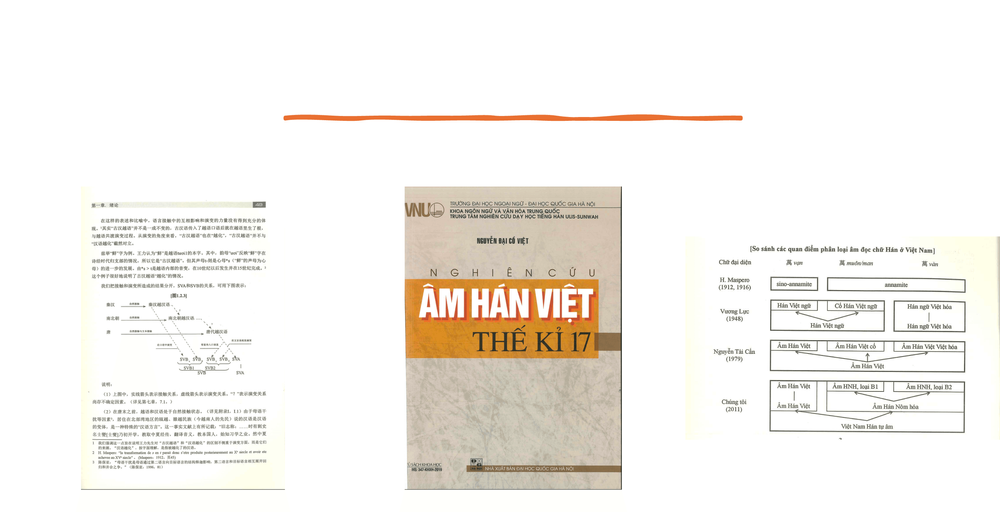
The book Nghiên cứu âm Hán Việt thế kỷ 17 (A Study of Hán-Việt Readings in the 17th Century, Vietnam National University Press, Hanoi, 2019, written in Chinese) by Dr. Nguyễn Đại Cồ Việt is a significant scholarly contribution to the field of historical linguistics. It focuses on re-examining and reinterpreting the system of Chinese character readings in Vietnamese through both theoretical and empirical approaches. Based on the author’s doctoral dissertation at Peking University, the work not only synthesizes previous scholarship but also revisits fundamental issues concerning the naming, classification, and interpretation of Sino-derived vocabulary in Vietnamese. In a field with a long research tradition, the book’s key contribution lies in proposing a more systematic framework that addresses unresolved ambiguities in earlier models.
Redefining “Hán-Việt” and a New Classification Framework
A central starting point of the study is the author’s decision not to adopt the conventional term “Hán-Việt vocabulary” (Hán-Việt ngữ) but instead to propose the concept of “Vietnamese readings of Chinese characters” (Việt Nam Hán tự âm), encompassing all forms of Chinese character readings in Vietnamese. This shift reflects the need to move beyond traditional classifications that lack sufficient flexibility to account for the complexity of historical linguistic phenomena.
Within this framework, the system is divided into two main categories: Type A (SVA), corresponding to standard Hán-Việtreadings used in formal, scholarly, and literary contexts; and Type B (SVB), referring to Hán-Nômized readings, which have been fully integrated into spoken Vietnamese and are no longer perceived as foreign elements. Importantly, this classification is supported by clearly defined criteria and a structured analytical process, enabling more precise distinctions between different lexical layers while overcoming limitations of earlier tripartite models. As such, the study not only revises terminology but also provides an effective analytical tool for historical phonology.
Engaging with and Extending Previous Scholarship
Nguyễn Đại Cồ Việt’s work positions itself in dialogue with a long lineage of scholarship, particularly the foundational studies of Henri Maspero and Wang Li. While Maspero pioneered the systematic study of Hán-Việtin the early twentieth century, Wang Li later developed a highly influential tripartite classification model. However, the author argues that these earlier frameworks remain limited, especially in their lack of clear criteria for distinguishing between layers and handling intermediate cases.
By introducing two core criteria, namely, the degree of formality of a reading and the extent to which historical phonological features are preserved, the book offers a more coherent and systematic approach. This framework helps clarify the boundaries between different strata of Sino-derived vocabulary and contributes to resolving long-standing debates surrounding categories such as “Ancient Hán-Việt” and “Vietnamized Chinese.” (Hán ngữ Việt hoá)
The Concept of “Internal Contact” and a New View of Phonological Change
One of the book’s most notable theoretical contributions is the concept of “internal contact.” According to this perspective, the incorporation of a large number of Chinese elements into Vietnamese did not merely expand its lexicon, but also resulted in the coexistence of two phonological subsystems: one associated with Hán-Việtreadings and another with native Vietnamese vocabulary. These subsystems do not remain separate; rather, they interact, overlap, and influence one another, leading to phonological changes within Vietnamese itself.
This approach allows phenomena such as the transformation from cẩm to gấm to be understood not as isolated irregularities, but as outcomes of systematic internal processes. More broadly, it expands traditional theories of language contact, which typically focus on interactions between distinct languages, by highlighting dynamic interactions within a single language shaped by extensive borrowing.
Investigating 17th-Century Sino-Vietnamese: Sources and Methodology
The core of the book is an investigation of Hán-Việtreadings in the 17th century, based on early quốc ngữ sources such as the Dictionarium Annamiticum Lusitanum et Latinum (1651) and Historia do Reino de Annam (1659). These sources are particularly valuable because they capture a transitional stage in the history of Vietnamese, when the romanized script began recording contemporary pronunciations.
Through the construction of a linguistic database, the establishment of identification criteria, the analysis of phonological correspondences, and the examination of exceptional cases, the author reconstructs a relatively detailed picture of the Hán-Việt system of the period. Beyond this, the study sheds light on broader developments in Vietnamese orthography and pronunciation, thereby contributing important data for the study of the historical evolution of the language.
Scholarly Significance and Future Directions
Taken together, A Study of Hán-Việt Readings in the 17th Century can be seen as a foundational contribution to the study of Vietnamese linguistic history. Its proposed classification framework and the concept of internal contact not only reshape our understanding of Hán-Việt but also open new avenues for investigating related linguistic phenomena.
At the same time, the work highlights areas that remain in need of further research, particularly the identification and systematic description of Hán-Nômized readings, a complex zone of interaction between borrowed and native elements. These open questions underscore the book’s lasting value, not only as a completed study but also as a starting point for future research in Hán-Nôm studies and Vietnamese studies more broadly.
Read this book on the Digitizing Vietnam platform:
https://www.digitizingvietnam.com/en/our-collections/nghien-cuu-han-nom/nghien-cuu-am-han-viet-the-ky-17