In Memory of Professor Nonna V. Stankevic: The Vietnamese Linguistic Tradition and Its Contacts with the Chinese Tradition
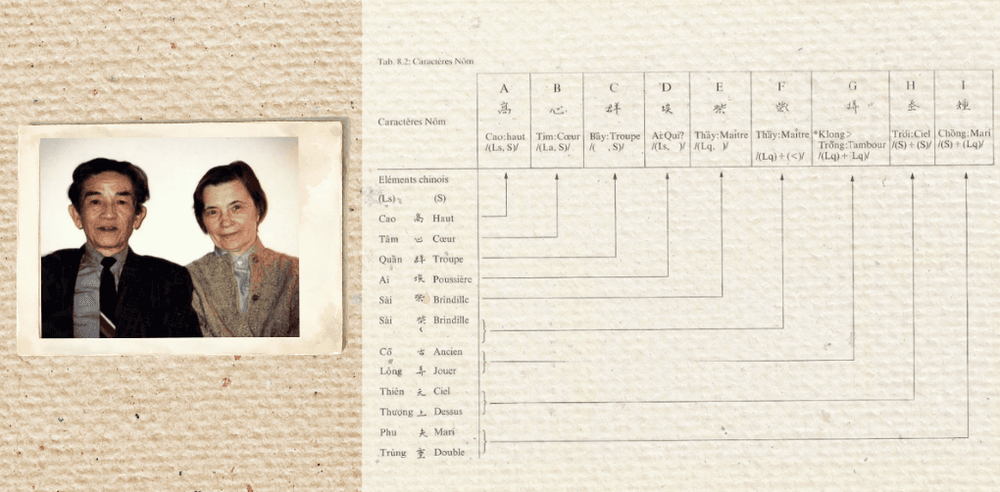
On April 3, 2026, in Moscow, Professor Nonna V. Stankevic, a distinguished scholar who devoted much of her life to the study of the Vietnamese language, passed away. She was also the wife and scholarly companion of the renowned Vietnamese linguist Professor Nguyễn Tài Cẩn.
Last year, Professor Stankevic personally shared with Digitizing Vietnam a copy of one of her important publications. Today, we would like to introduce this work to our readers in memory of her and her lifelong contributions to Vietnamese linguistic studies.
The chapter, “La tradition linguistique vietnamienne et ses contacts avec la tradition chinoise” (The Vietnamese Linguistic Tradition and Its Contacts with the Chinese Tradition), was published in French in 2000 in Volume 1 of History of the Language Sciences / Geschichte der Sprachwissenschaften / Histoire des sciences du langage: An International Handbook on the Evolution of the Study of Language from the Beginnings to the Present, published by Walter de Gruyter and edited by Sylvain Auroux, E. F. K. Koerner, Hans-Josef Niederehe, and Kees Versteegh.
In this concise but wide-ranging study, Professor Stankevic traces the historical development of Vietnamese linguistic thought, paying particular attention to its centuries-long interaction with the Chinese scholarly tradition. She examines successive layers of Chinese influence on Vietnamese vocabulary and pronunciation, the development of Sino-Vietnamese readings, and the ways Vietnamese scholars adapted knowledge inherited from Chinese linguistic traditions to the distinctive characteristics of their own language.
The chapter also provides a valuable account of the history of Vietnamese lexicography and chữ Nôm. Professor Stankevic discusses early dictionaries and linguistic works produced by Vietnamese scholars and examines how chữ Nôm developed from Chinese characters through borrowing and the creation of new characters combining phonetic and semantic elements. Her discussion shows that Vietnamese scholars were not simply passive recipients of an external intellectual tradition: they adapted inherited systems of writing and linguistic knowledge to represent and study Vietnamese.
The story continues into the modern period with the emergence of chữ Quốc ngữ. Professor Stankevic discusses the role of seventeenth-century European missionaries, including the importance of Alexandre de Rhodes's 1651 dictionary, before tracing the growing use of the Romanized script and the emergence of modern Vietnamese lexicography and linguistic scholarship.
Seen as a whole, the chapter presents the Vietnamese linguistic tradition as the product of a long history of encounter, adaptation, and intellectual creativity—from indigenous Vietnamese practices and sustained engagement with Chinese scholarship to later encounters with European linguistic traditions.
For Digitizing Vietnam, this particular copy also carries a meaning beyond its scholarly content. It came to us directly from Professor Stankevic herself. Preserving and sharing it is therefore not only a way of making an important work on Vietnamese linguistic history accessible to new readers, but also a small act of remembrance.
Through this article, we remember Professor Nonna V. Stankevic and honor her lifelong dedication to the study of the Vietnamese language and its intellectual history.
In memory of Professor Nonna V. Stankevic (1935–2026).
Read the full article in French on the Digitizing Vietnam Platform: